 by
by What makes a story feel truly like “Star Wars”? According to director Kenji Kamiyama, it is not simply about becoming a Jedi. In a new interview, the director discusses the making of “Star Wars: Visions/The Ninth Jedi,” the importance of the Force and lightsabers, the relationship between Kara and her father, the mysterious Naworm, and his vision for the future of the franchise.
“Star Wars: Visions/The Ninth Jedi,” the first full-length animated series in the “Star Wars: Visions” project to originate from Japan, premiered exclusively on Disney+ on August 5 in Japan and the United States.
“Star Wars: Visions” is an ambitious Lucasfilm project that gives animation creators around the world the opportunity to reinterpret the “Star Wars” universe through their own creative perspectives. Rather than requiring every story to follow the same style, the project allows different studios and filmmakers to explore new characters, visual approaches and interpretations of the franchise.
For the latest feature-length project, director Kenji Kamiyama and Production I.G take on the challenge of expanding the world introduced in the earlier “The Ninth Jedi” short.
The result is a story centered on Kara, a young woman with extraordinary Force abilities, and her mysterious enemy Naworm, a masked warrior whose appearance immediately recalls the iconic image of Darth Vader.
The series combines lightsaber battles, space adventure, family drama, and questions about the nature of the Force. But beneath the action, Kamiyama says he wanted to explore a more fundamental question: What does it really mean to be a hero in the “Star Wars” universe?
Why Kamiyama Accepted the “Star Wars” Challenge
Kamiyama explained that the idea of expanding “The Ninth Jedi” into a longer project had already existed during the production of the original short.
The first volume of “Star Wars: Visions” consisted of nine short films created by different animation studios. Kamiyama directed “The Ninth Jedi,” which introduced Kara, her father,r and a mysterious future in which the Jedi have seemingly disappeared.
The short attracted considerable attention, particularly overseas.
According to Kamiyama, the production team had already created enough background material and character history to imagine the story continuing beyond the short-film format.
That possibility eventually reached Lucasfilm.
“It was a project I wanted to challenge myself with.”
For Kamiyama, the opportunity had an especially personal meaning.
He had been a “Star Wars” fan since childhood, and the franchise was one of the reasons he became interested in filmmaking.
Therefore, receiving an offer from Lucasfilm was exciting even when the project was initially a short film. Turning that story into a longer series made the experience even more significant.
At the same time, the scale of the franchise created enormous pressure.
Rather than simply feeling like a dream come true, Kamiyama described the experience as a mixture of excitement and responsibility.
Working with one of the world’s most recognizable science-fiction franchises meant that every creative decision would inevitably be compared with decades of “Star Wars” history.
From a Short Film to an Eight-Episode Series
One of the biggest challenges was expanding the story.
The original concept had enough material for a larger narrative, but turning it into an eight-episode series required Kamiyama and his team to carefully reconsider the pacing.
A feature-length story and an episodic series have different storytelling needs.
The creators had to decide:
- How much of the story should be revealed in each episode?
- How should the characters’ backgrounds be expanded?
- Who are the remaining Jedi?
- How should the mystery surrounding Kara’s family develop?
- How can the story maintain momentum across multiple episodes?
- How much action should be balanced with character development?
Kamiyama joked that the total runtime eventually approached the length of a feature film, making the task particularly demanding.
However, the larger format also allowed the team to explore ideas that could only be hinted at in the original short.
What Makes a Story Feel Like “Star Wars”?
One of the most interesting parts of the interview concerns Kamiyama’s definition of “Star Wars-ness.”
For him, there are several essential elements.
The first are Jedi and lightsabers.
However, he believes that “Star Wars” is not simply a story about Jedi fighting with lightsabers.
At its heart, he sees the franchise as an adventure story about ordinary or relatively unknown individuals who become involved in extraordinary events.
That sense of adventure is important.
Characters travel through space, visit unfamiliar planets, and encounter people and cultures they have never seen before.
Even if a character never becomes a Jedi, Kamiyama believes that this sense of discovery can still make a story feel like “Star Wars.”
The Strange and Wonderful Technology of “Star Wars”
Kamiyama also pointed to another recognizable feature of the franchise: its technology.
The machines and gadgets in “Star Wars” often look unusual, improvised, and slightly worn.
They do not always resemble perfectly designed futuristic technology.
Some machines appear to have been assembled from different parts, yet they can somehow travel through space.
That contrast gives the universe its distinctive personality.
Kamiyama noted that “Star Wars” does not spend too much time explaining exactly how every machine works.
Instead, the audience simply accepts that these strange devices exist.
This approach allows the fictional world to feel imaginative rather than overly technical.
The Force Remains at the Center of the Story
Of course, no discussion of “Star Wars” would be complete without the Force.
For Kamiyama, the Force is one of the most important elements because it gives the franchise its fantasy dimension.
Science-fiction technology creates the setting, but the Force introduces mystery, spirituality and philosophical questions.
That is particularly important in “The Ninth Jedi,” where the conflict between the light side and the dark side becomes more complicated than a simple battle between good and evil.
The new series asks whether the two sides can really be separated so easily.
Why Lightsaber Battles Were One of the Biggest Challenges
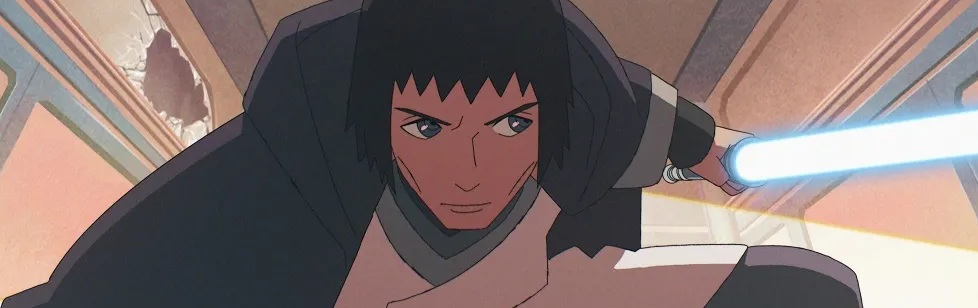
Lightsaber combat is one of the most iconic elements of “Star Wars,” but translating it into animation is extremely difficult.
A convincing lightsaber fight requires much more than simply drawing characters swinging glowing swords.
The movement has to feel fast, powerful and physically believable.
Timing is also extremely important.
Every strike, block, dodge and counterattack has to communicate the weight and speed of the combat.
Kamiyama explained that these sequences require enormous amounts of time and effort from animators.
Fortunately, the project attracted talented artists from around the world.
Although Production I.G is a Japanese animation studio, the “Star Wars” connection allowed creators from different countries to participate.
As a result, the series features extensive lightsaber action and some of the project’s most visually ambitious sequences.
For longtime “Star Wars” fans, the sword fights are likely to be one of the biggest attractions.
Kara: A New Kind of “Star Wars” Hero
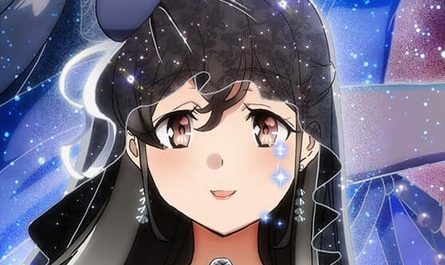
At the center of the story is Kara, a young woman with powerful Force abilities.
Kamiyama wanted her to be a character that audiences could quickly connect with.
Rather than beginning as a completely inexperienced hero, Kara is already capable and skilled.
She is also energetic and positive, giving her a different personality from many traditional “Star Wars” protagonists.
However, she is not perfect.
She experiences setbacks and has weaknesses that become important to her development.
This was essential because the creators wanted the audience to experience her growth throughout the story.
The Father-Daughter Relationship Behind the Action
Another important element is Kara’s relationship with her father, Zeema.
The parent-child relationship is one of the most recognizable themes in “Star Wars.”
The original saga famously explored the relationship between Luke Skywalker and Darth Vader, while other stories have also focused on the relationship between mentors and students.
Kamiyama sees this kind of relationship as a central part of the franchise’s storytelling tradition.
In “The Ninth Jedi,” the relationship is transformed into a father-daughter dynamic.
That allows the series to explore familiar “Star Wars” themes while presenting them from a different perspective.
Kara’s journey is not only about becoming stronger.
It is also about understanding her father, questioning his choices,s and deciding what kind of person she wants to become.
Naworm: A Villain Who Challenges the Meaning of Good and Evil
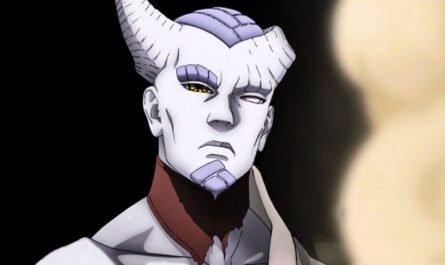
Perhaps the most mysterious character in the series is Naworm.
His masked appearance immediately evokes Darth Vader, creating the impression that he is a traditional dark-side villain.
However, Kamiyama wanted to challenge that expectation.
In older “Star Wars” stories, the light side and dark side could often be understood as clear opposites.
The Jedi represented the light, while the Sith represented the dark.
But modern audiences are increasingly interested in characters whose motivations cannot be divided so neatly.
A character can believe they are doing the right thing while causing harm.
Likewise, someone who appears dangerous may have understandable reasons for their actions.
That ambiguity is central to Naworm.
Why Does Naworm Have a Blue Lightsaber?
One of the intriguing mysteries surrounding Naworm is the color of his lightsaber.
His appearance suggests a connection to the dark side, yet he carries a blue lightsaber, traditionally associated with Jedi.
This creates an immediate question:
If Naworm represents the dark side, why does he have a blue lightsaber?
The answer is connected to the larger philosophical questions explored throughout the series.
Rather than simply asking who is good and who is evil, the story encourages viewers to question how those labels are created.
Naworm is voiced by Nao Omori, whose distinctive performance gives the character an imposing and mysterious presence.
The Mystery of Kara’s Father
The mystery surrounding Zeema is another major part of the story.
The original short established that Kara’s father had experienced a major transformation.
At one point, he appeared connected to the light side, but eventually fell toward the dark side.
The feature-length series expands this mystery.
Kamiyama explained that viewers should pay attention to the reasons behind Zeema’s choices and the questions he struggled with.
His journey is connected to the larger dilemma between the light and dark sides of the Force.
This is one of the reasons the director recommends watching the series more than once.
Information that seems mysterious during an early episode may take on a different meaning after viewers understand the full story.
Who Is the “Ninth Jedi”?
The title itself remains an important clue.
The original “The Ninth Jedi” introduced the mystery surrounding the remaining Jedi and the meaning of the title.
As the story develops, viewers are encouraged to consider what it means to be a Jedi in a world where the traditional Jedi order has disappeared.
The identity of the “ninth Jedi” is not simply a mystery designed to create a surprise.
It also connects to the central question of the series:
What does it truly mean to follow the Jedi path?
Kara’s journey gradually becomes an exploration of that question.
A New Interpretation of the Jedi and Sith
One of the strongest ideas in the series is that the traditional conflict between Jedi and Sith may not be as simple as it first appears.
Kamiyama believes that the way audiences view morality has changed.
Modern stories frequently explore characters who exist somewhere between traditional definitions of hero and villain.
That change in storytelling is reflected in “The Ninth Jedi.”
The series still contains familiar elements such as lightsabers, Jedi, the Force and space battles, but it uses those elements to ask more complicated questions.
This is one of the ways “Star Wars: Visions” can expand the franchise without simply repeating the original saga.
Why “Star Wars: Visions” Is Important for Anime Fans
“Star Wars: Visions” represents an unusual meeting between Hollywood science fiction and Japanese animation.
Instead of asking Japanese creators to reproduce the style of existing “Star Wars” films, Lucasfilm gives them room to bring their own animation traditions and storytelling techniques to the universe.
That makes the project especially interesting for anime fans.
Production I.G’s involvement adds another layer of significance, particularly given the studio’s long history of ambitious science-fiction and action animation.
Kamiyama’s experience with large-scale animated projects also gives the series a distinct cinematic quality.
What Does Kamiyama Want to Do Next?
When asked about his future ambitions, Kamiyama said there are many projects he would like to explore.
He also expressed interest in expanding the world of this “Star Wars” story further.
Since the main “Star Wars” films are traditionally associated with live-action filmmaking, he would also like to experience creating a live-action “Star Wars” film someday.
For Kamiyama, the universe remains vast enough that there are still many stories he has not been able to tell.
He believes every creator may have their own interpretation of what “Star Wars” means.
That creative freedom is also one of the greatest strengths of “Star Wars: Visions.”
Final Thoughts: “Star Wars” Is More Than Jedi and Lightsabers
Kenji Kamiyama’s comments reveal that his goal with “Star Wars: Visions/The Ninth Jedi” was not simply to create another lightsaber battle.
The series uses familiar elements of the franchise while asking new questions about identity, family, morality, the Force and the meaning of being a Jedi.
At its core, Kamiyama’s definition of “Star Wars” is surprisingly simple.
You do not necessarily need to become a Jedi.
You do not even need to follow the traditional path of the heroes from the original films.
What matters is the feeling of adventure, discovery, mysterious worlds, unforgettable characters, and the struggle to find your own path.
That philosophy makes “The Ninth Jedi” an especially interesting entry in the growing “Star Wars: Visions” universe.
For longtime fans, it offers familiar concepts through a new lens. For anime viewers who may not know every detail of “Star Wars” history, it provides an accessible introduction to the franchise’s core ideas.
And for Kamiyama himself, this may only be the beginning.