 by
An intriguing new original anime project is making its debut with the release of a pilot film. NINJA SKOOLER, directed by Shunsuke Takarai, has unveiled its first animated footage, introducing a heartfelt story about a lonely boy, two real ninjas, and the unexpected bonds that bring people together.
Released on November 6, 2026, the pilot film offers a first look at the project’s characters, visual style, and emotional atmosphere. Alongside the video, the anime’s featured song, “Musubime” (Knots), performed by singer-songwriter Takashi Iwami, has also become available on music-streaming platforms.
Rather than focusing entirely on ninja battles and action, NINJA SKOOLER explores the connections between people and the importance of having a place to belong. Its story follows Rappa, an orphaned boy who dreams of becoming a ninja. After a dangerous incident on a snowy night, he is rescued by a real ninja named Okachimachi and his master. The encounter changes his life, eventually giving him a new home and a family-like bond with his rescuers.
The pilot film introduces several important moments from this journey, including Rappa’s first meeting with the two ninjas, the lively candy shop run by his master, and a peaceful scene in which the three characters watch fireworks together.
With its distinctive animation approach, original music, and emotional storytelling, the project offers an interesting new interpretation of the ninja genre.
NINJA SKOOLER Pilot Film Released on November 6
The original animated project NINJA SKOOLER was developed under the direction of Shunsuke Takarai, who also handles storyboarding and episode direction.
The pilot film was officially released on November 6, 2026, through the project’s promotional channels. It introduces the central characters and provides an overview of the story’s emotional direction.
The footage moves between different moments in Rappa’s life, showing how a chance encounter can change the future of someone who has nowhere to go.
One of the most memorable scenes takes place on a snowy night. Rappa, a boy who admires fictional ninjas, falls from a rooftop and is rescued by Okachimachi and his master. Rather than simply leaving the boy behind, the two ninjas become important figures in his life.
Rappa subsequently visits their home and asks to become their apprentice. His determination to learn the ways of a ninja eventually leads to the three living together like a family.
The pilot also offers glimpses of their everyday lives. The master’s candy shop becomes a gathering place for children, creating a warm atmosphere that contrasts with the dangerous circumstances surrounding Rappa’s early life.
Another scene shows the three characters watching fireworks together. This peaceful moment highlights the emotional heart of the project: the importance of companionship and the small experiences that make a place feel like home.
Story: A Lonely Boy Finds a New Family Through Two Ninjas
At the centre of NINJA SKOOLER is Rappa, an orphaned boy who dreams of becoming a ninja like the fictional heroes he admires.
Unlike the legendary characters found in stories, however, Rappa’s journey begins in a difficult and lonely situation. He has no family to rely on and struggles to find a place where he belongs.
One snowy night, he falls from a rooftop. Fortunately, he is saved by Okachimachi, a real ninja, and the ninja’s master.
This unexpected encounter becomes a turning point in his life.
After being rescued, Rappa approaches the two and asks to become their apprentice. His enthusiasm and determination eventually lead him to live with them, creating a household that gradually becomes a family.
As the years pass, Rappa grows up while continuing to pursue his dream. He wants to become a ninja who protects the town and the people living in it.
The master’s candy shop also becomes an important part of their everyday life. Children gather there, and the shop develops into a welcoming place filled with laughter and activity.
For Rappa, these ordinary moments are precious. After spending much of his childhood alone, he has finally found people he can depend on.
However, the peaceful life he has come to cherish is not guaranteed to last forever.
One day, Rappa sees Okachimachi caring for their master and catches a glimpse of the suffering that the older ninja has been hiding. This discovery forces him to confront a difficult reality about the person who has become like a parent to him.
The pilot’s story therefore introduces more than a conventional tale about a young boy learning ninja techniques. It hints at a deeper drama involving family, ageing, hidden pain, and the possibility that even the strongest bonds can change.
A Ninja Story Focused on Human Relationships
The ninja genre is often associated with secret missions, stealth, martial arts, and spectacular battles. NINJA SKOOLER uses the familiar image of ninjas but places greater emphasis on the relationships between its characters.
Director Shunsuke Takarai explained that he wanted to use the distinctive existence of ninjas as the motif for a universal story about human connections.
A chance meeting can change someone’s life for the better. At the same time, relationships that seem permanent can sometimes be unexpectedly interrupted.
These ideas are reflected in Rappa’s journey.
His meeting with Okachimachi and the master gives him a new direction in life. Their home becomes a place where he can grow, learn, and experience the affection he previously lacked.
However, the story also acknowledges that relationships are not always simple. People experience difficulties, hide their suffering, and sometimes find themselves separated from those they care about.
This emotional perspective gives the project a different identity from a traditional action-focused ninja anime.
The story’s central question is not simply whether Rappa can become a powerful ninja. It is also about what kind of person he will become and how the relationships he forms will shape his future.
Distinctive Animation Without Traditional Outlines
One of the most interesting aspects of the pilot film is its visual presentation.
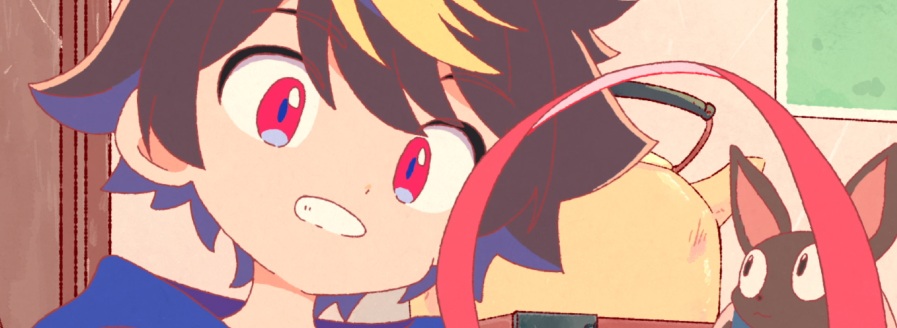
Takarai revealed that he challenged himself to use an animation style without traditional character outlines. This approach was chosen to express the uncertainty and vulnerability associated with childhood.
In many anime productions, characters are separated clearly from their backgrounds through visible outlines. This helps define their shapes and makes their movements easy to follow.
NINJA SKOOLER takes a different direction by allowing the characters and backgrounds to feel more closely connected.
The absence of strong outlines creates a softer visual impression, making the characters appear as though they belong naturally within their surroundings.
This is particularly suitable for a story that focuses on everyday experiences, childhood memories, and emotional relationships.
The snowy rooftop, the candy shop, and the fireworks scene all benefit from an atmosphere in which the characters and their environment feel connected rather than visually separated.
Takarai hopes viewers will appreciate this sense of unity between the background artwork and character animation.
The visual style also gives the pilot a distinctive identity. Instead of relying only on detailed mechanical effects or elaborate action sequences, the project uses its artistic direction to communicate the characters’ feelings.
“Musubime”: Takashi Iwami’s New Song Released Alongside the Pilot
Another major highlight of the announcement is the release of “Musubime” (Knots), the featured song created for NINJA SKOOLER.
The track is performed, written, and composed by Takashi Iwami, who is also known by his Vocaloid producer name, Nanahoshi Orchestra.
The song was released on November 6, the same day as the pilot film, and is available through major music-streaming services.
Its title, which refers to knots or the act of tying something together, directly connects to the anime’s central theme of human relationships.
Iwami explained that he imagines connections between people as threads containing countless different knots.
Some connections are tied tightly, while others become tangled. Some are broken and later tied together again. There are also relationships whose true importance becomes clear only after people have been separated.
Each encounter changes the people involved, and those experiences eventually connect them to someone else.
This idea reflects the story of Rappa, whose unexpected meeting with Okachimachi and the master changes the direction of his life.
The song’s message also extends beyond the fictional characters. Iwami expressed his hope that the connections created through the project would reach listeners and become part of their own experiences.
Takashi Iwami’s background
Takashi Iwami has developed a distinctive musical identity through his work as the Vocaloid producer Nanahoshi Orchestra.
A Vocaloid producer is a musician who creates songs using voice-synthesis software, often developing original compositions and musical arrangements for digitally generated vocals.
Iwami has also been expanding his activities as a singer-songwriter under his own name. His self-performed music project began gaining momentum with the release of “Drip” in December 2025.
In 2026, he released additional music, including “Oni ni Naru,” featured in the children’s television programme Synapusyu, and “Katarinaoshi.”
His involvement in NINJA SKOOLER adds another creative element to the project, with the song providing an emotional connection to the story rather than functioning simply as background music.
Director Shunsuke Takarai Explains the Project’s Central Theme
Director Shunsuke Takarai shared a message explaining the ideas behind NINJA SKOOLER and its featured song.
He said that he wanted to create a universal story about the connections between people, using the unusual world of ninjas as its central motif.
For Takarai, an unexpected encounter can improve someone’s life, while relationships that have already been formed can sometimes be broken in ways people never anticipated.
He also expressed how important “Musubime” had become to him, explaining that Iwami had written the song to capture these subtle emotional changes.
Takarai’s comments also provide insight into the visual direction. He explained that the outline-free animation style was chosen to express the uncertainty and vulnerability of children.
Rather than separating the characters sharply from their surroundings, the production aims to create a unified atmosphere in which the backgrounds and characters feel like parts of the same world.
His approach suggests that the pilot is intended to communicate emotion through both storytelling and visual design.
Takashi Iwami Shares His Thoughts on the Meaning of “Musubime”
Iwami also shared a message about the song and its connection to the anime.
He described human relationships as threads containing countless knots, each with its own shape and meaning.
Some bonds remain tightly connected, while others become tangled or temporarily come undone. Even when a connection is broken, it may be possible to tie it again in a different way.
He also reflected on how separation can sometimes help people recognise the importance of a relationship.
Every encounter changes us, and those experiences can eventually connect us to people we have not yet met.
His message asks listeners to think about the people waiting at the other end of those threads and the kinds of connections they may choose to build.
This interpretation makes the song especially relevant to Rappa’s story. His life changes because of a single encounter, but the relationships he forms continue to influence his future.
Iwami hopes that the story and its music will create new connections with viewers and listeners.
Main Staff and Animation Production Details
NINJA SKOOLER brings together creators from animation, character design, music, and visual production.
Shunsuke Takarai leads the project as director, storyboard artist, and episode director. Manga artist Hami is responsible for the original character concepts, while Hiroko Oguri handles the character designs for animation.
The production also includes experienced staff working on props, background art, colour, cinematography, editing, sound, and music.
Notably, the music is composed by Kevin Penkin, known internationally for his work on anime soundtracks. His involvement adds another point of interest for viewers who appreciate music-driven animation.
The project is produced by BLUE RIGHTS, with animation production credited to Breccia and Kinema Citrus.
BLUE RIGHTS Seeks Partners to Expand the NINJA SKOOLER Project
Another interesting detail in the announcement is that BLUE RIGHTS is looking for co-creation and joint-production partners for NINJA SKOOLER.
The project is intended to develop into a broader intellectual property (IP), rather than being limited to the pilot film alone.
An intellectual property, or IP, is a creative property that can be developed across different forms of entertainment and merchandise. Popular anime franchises often expand through manga, novels, music, games, short videos, character products, and international distribution.
According to BLUE RIGHTS, the project aims to explore opportunities across several areas, including:
- Publishing: Manga, novels, and children’s books.
- Music: Theme songs, soundtrack releases, and collaborations with artists.
- Digital content: Additional digital entertainment and short-form videos.
- Character merchandise: Toys, accessories, everyday goods, and apparel.
- International development: Localization, overseas distribution, and international co-productions.
The company is seeking partners who can help develop these areas and expand the project’s reach.
This is an important part of the announcement because it provides a clearer picture of the project’s ambitions. The creators are looking beyond the initial pilot and considering how the characters and story could reach audiences through multiple forms of entertainment.
However, the search for partners should not be confused with confirmation of a full television anime, a release schedule, or a completed series production.
The pilot film is currently the confirmed animated release, and further developments will depend on future project announcements.
What Makes NINJA SKOOLER Worth Watching?
There are several reasons why NINJA SKOOLER stands out among new original anime projects.
First, its approach to the ninja genre is different from what viewers might expect. Rather than presenting ninjas only as mysterious warriors involved in dangerous missions, the project uses them as the foundation for a story about family and human relationships.
Second, Rappa’s journey offers an emotional starting point. He is a lonely boy who finds a new home through an unexpected encounter. His desire to become a ninja who protects the town gives him a goal, but the relationships he develops with Okachimachi and the master provide the story with its emotional depth.
Third, the visual direction is particularly distinctive. Takarai’s decision to avoid traditional outlines gives the pilot a softer appearance and supports its themes of childhood, vulnerability, and the connection between people and their surroundings.
Finally, the involvement of Takashi Iwami and Kevin Penkin adds considerable musical interest. “Musubime” is closely connected to the story’s themes, while Penkin’s involvement in the score gives the production another notable creative contributor.
Together, these elements suggest that NINJA SKOOLER is aiming to become more than a conventional ninja adventure.
A Story About the Bonds That Change Our Lives
The pilot film for NINJA SKOOLER introduces a promising original anime project centred on an orphaned boy who finds a new family through two real ninjas.
Its story combines familiar ninja imagery with a more personal exploration of companionship, childhood, hidden suffering, and the importance of human connections.
The animation’s outline-free visual style gives the project a distinctive atmosphere, while Takashi Iwami’s “Musubime” reinforces the emotional themes through music.
The involvement of Studio Hare, Kinema Citrus, BLUE RIGHTS, and composer Kevin Penkin also makes the project worth following as it develops.
Although a full television series or release schedule has not yet been announced, BLUE RIGHTS’ search for creative and production partners suggests that the team is interested in expanding the project beyond the pilot.
For now, the first film offers viewers an introduction to Rappa, Okachimachi, and their master, along with a glimpse of the relationships that will shape their story.
Sometimes, a single encounter can change the direction of an entire life. That is the central idea behind NINJA SKOOLER, and it is what makes this new original anime worth keeping an eye on.