 by
by Spoiler warning: This review discusses major themes, character development, and several important story elements from THE RIBBON HERO. Major plot twists are avoided where possible, but readers who want to experience the film completely blind may want to watch it first.
The anime film “THE RIBBON HERO” began streaming worldwide exclusively on Netflix on August 8, 2026. Based on Osamu Tezuka’s legendary manga Princess Knight, the movie does not attempt to reproduce the original story scene for scene. Instead, it takes the central idea of Tezuka’s classic and rebuilds it as a new fantasy-action film for a modern audience.
That decision is likely to produce both praise and criticism.
For viewers who want a faithful adaptation of Princess Knight, some of the changes may feel surprisingly drastic. The film alters important aspects of Sapphire’s character, her circumstances, and the reason she becomes a hero. At the same time, those changes allow the new movie to ask a different question:
What kind of hero does the world need in 2026?
Rather than simply copying the original Princess Knight, THE RIBBON HERO tries to carry forward its spirit.
The result is a film that is straightforward, colorful, energetic, and sometimes deliberately old-fashioned in its approach to heroism. It combines fantasy adventure, transformation-hero elements, comedy and emotional drama while placing a modern interpretation of Sapphire at its center.
And that may ultimately be the movie’s greatest strength.
A bold new interpretation of Osamu Tezuka’s “Princess Knight”
Before discussing the film itself, it is important to understand what THE RIBBON HERO actually is.
The movie is based on Osamu Tezuka’s Princess Knight rather than being a strict recreation of the original manga. Netflix describes it as a modern treatment of the 1953 classic, with director Yuki Igarashi making his feature-length directorial debut. The production is handled by OUTLINE, with Twin Engine producing the project.
The official story follows Princess Sapphire of Silverland after her homeland is destroyed by a calamity known as Nergal. She eventually reaches Goldland, where she begins rebuilding her life and discovers kindness and hope. When Nergal appears again and threatens her new home, Sapphire decides that she will not allow anyone else to experience the same loss. She takes up her sword and becomes the hero who chooses to defy fate.
That setup is already very different from the familiar premise of the original Princess Knight.
And that difference is intentional.
A straightforward “hero story” in an era of complicated heroes
One of the most refreshing things about THE RIBBON HERO is how straightforward it is.
Modern anime frequently features protagonists who are morally complicated, cynical, traumatized, or uncertain about what they should do.
Sapphire is different.
She suffers.
She loses people and her homeland.
She becomes discouraged.
But when she sees someone in trouble, her instinct is still to help.
There is something almost nostalgic about that approach.
The film is not embarrassed to say that helping people is good.
It is not afraid of emotional declarations.
It is not afraid of friendship.
It is not afraid of hope.
And it is certainly not afraid of the idea that a hero should stand up when everyone else has given up.
That simplicity can occasionally feel predictable, but it also gives the movie an unusual sincerity.
In an era when many stories deliberately complicate the definition of heroism, THE RIBBON HERO asks whether there is still value in a hero who simply says:
“Someone needs help, so I will help them.”
That is an old-fashioned idea.
But perhaps that is precisely why it works.
The biggest change: Sapphire begins by losing everything
The original Princess Knight is built around Sapphire’s unusual identity and her position as a princess who must live and fight in a male role.
The character has traditionally been associated with the tension between masculinity and femininity, identity and social expectations, duty and personal desire.
That aspect of the original was remarkably forward-looking.
THE RIBBON HERO, however, chooses a different starting point.
Sapphire begins the story after her homeland, Silverland, has already been destroyed by Nergal.
She arrives in Goldland carrying the weight of that loss.
This is a significant change because the new Sapphire does not initially have the same political motivation as the original character.
She has lost her home.
She has lost her sense of security.
And, perhaps most importantly, she has lost her reason to fight.
The film therefore begins not with a confident hero, but with a girl who has experienced overwhelming loss.
That gives her eventual transformation a different emotional meaning.
A Sapphire without the original disguise
One of the most noticeable changes for fans of Princess Knight is that this Sapphire does not simply reproduce the original character’s male disguise.
In Tezuka’s classic, Sapphire’s identity as a girl raised to fulfill a prince’s role is fundamental to the story.
It influences her relationship with the kingdom, her personal identity,y and the way other characters perceive her.
In THE RIBBON HERO, that framework has largely been removed.
Sapphire is presented openly as a girl.
She is not trying to deceive the world by pretending to be a prince.
For longtime fans, this may initially feel like the movie has removed one of the most recognizable elements of the source material.
And that criticism is understandable.
However, the movie is not simply throwing away the original character.
Instead, it transfers the idea of struggling against an imposed fate into another context.
From fighting against identity to fighting against resignation
This is where the film’s reinterpretation becomes particularly interesting.
The original Princess Knight asks questions about identity, gender roles, social expectations, ns and the right to determine one’s own future.
THE RIBBON HERO shifts that emphasis.
Its central conflict is closer to:
What happens when people stop believing that they can change anything?
Sapphire enters a world where disaster has become something people simply accept.
The calamity Nergal is treated as an overwhelming force.
People are encouraged to survive rather than resist.
Sacrifice becomes easier to justify when everyone believes resistance is impossible.
That creates a very different kind of conflict for Sapphire.
She is not only fighting a monster.
She is fighting the belief that nothing can be done.
The world of resignation
This idea of resignation is one of the film’s strongest themes.
In Goldland, there is an attitude that people should simply accept the existence of overwhelming forces.
The religious organization Mitra plays an important role in this worldview, presenting the idea that the weak inevitably become victims of greater powers.
For some viewers, this may recall real-world situations in which people become accustomed to crisis.
When a problem continues for a long time, people can gradually stop believing that it can be solved.
They may begin to think:
“That’s just how things are.”
“Someone else will deal with it.”
“There’s nothing I can do.”
“Resistance is pointless.”
THE RIBBON HERO turns that mentality into the central obstacle that Sapphire must overcome.
Nergal as more than a monster
Nergal is the obvious physical threat in the movie.
It is the calamity that destroys Silverland and later threatens Goldland.
But the film gives Nergal a symbolic dimension as well.
The story presents a society dealing with disaster through isolation, restrictions, and fear.
Because of that, it is difficult not to see echoes of the experiences of the COVID-19 era in the movie’s worldbuilding.
The comparison should not be taken as a literal one-to-one allegory, but the imagery of widespread restrictions, separation and collective fear makes the connection understandable.
The film was created in a period when audiences have experienced global crises firsthand.
That makes its discussion of fear and resignation particularly accessible to contemporary viewers.
Sapphire’s most important power is not her sword
Sapphire eventually becomes a powerful fighter.
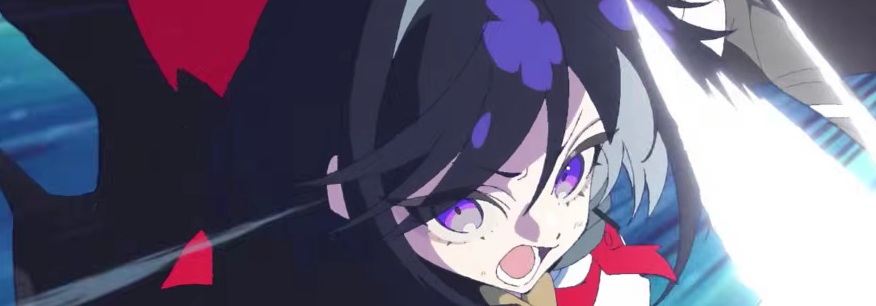
The action sequences are energetic, colorful, and deliberately direct.
But her most important ability is arguably something much simpler:
She refuses to give up on other people.
At one point, Sapphire expresses her desire to do something for someone even though she is unsure what she can actually do.
That uncertainty is important.
She does not begin as an all-powerful savior.
She begins by wanting to help.
Her relationship with Pine, who becomes her friend in Goldland, is especially important in this regard.
Instead of immediately solving the world’s problems, Sapphire first learns how to connect with another person.
Her idea of heroism therefore grows from relationships.
Pine represents a different kind of “Princess Knight” story
Pine is one of the characters who helps demonstrate how different this version of Sapphire is.
The original Sapphire is often placed in situations where she must carry enormous responsibilities by herself.
THE RIBBON HERO allows its protagonist to form meaningful friendships earlier.
That makes the film feel warmer.
Sapphire does not have to become a hero completely alone.
She discovers that helping someone can also mean standing beside them.
The friendship between Sapphire and Pine therefore works as more than simple comic relief or emotional support.
It represents the film’s broader belief that people can regain hope through connections with others.
Why the film feels like “Super Sentai” and “Pretty Cure”
Another distinctive feature of THE RIBBON HERO is its unapologetically classic approach to hero storytelling.
There are moments when the movie feels less like a modern psychological fantasy and more like a traditional transformation-hero series.
Sapphire transforms.
She takes up her sword.
She confronts powerful enemies.
She declares what she believes.
She protects people.
There is a wonderful lack of cynicism in these scenes.
The film does not constantly ask whether being a hero is foolish.
It simply allows Sapphire to be heroic.
That quality may remind viewers of Super Sentai and Pretty Cure, where transformation, friendship and courage are expressed openly.
This connection is not entirely surprising, given the involvement of screenwriter Junko Komura, whose credits include major Super Sentai and Pretty Cure projects.
The result is a film that understands the entertainment value of a hero who confidently steps forward when the situation looks hopeless.
A hero movie with a deliberately classic heart
The film’s approach can sometimes feel almost too straightforward.
There are moments when viewers may be able to predict where the story is going.
However, predictability is not necessarily a weakness when a story is intentionally built around emotional sincerity.
THE RIBBON HERO is not primarily interested in surprising the audience with morally ambiguous answers.
It wants the audience to feel something.
It wants viewers to cheer when Sapphire stands up.
It wants viewers to feel relieved when people choose hope instead of surrender.
It wants the act of helping another person to feel meaningful.
That is a very traditional approach to storytelling.
And in 2026, it can feel surprisingly refreshing.
The animation is one of the movie’s biggest strengths
Even viewers who are divided about the story’s changes may find plenty to appreciate visually.
The film features expressive character animation, dynamic action sequences,s and a fantasy world that shifts between elegant imagery and more playful visual styles.
The character designs are by illustrator Kei Mochizuki, with character-concept collaboration from Mai Yoneyama. Issei Aramaki serves as animation character designer, while Cédric Hérole is credited as art director.
Director Yuki Igarashi brings his background as an animator into the project.
He previously gained attention for work including Star Wars: Visions and animation work connected to Jujutsu Kaisen, before taking on THE RIBBON HERO as his first feature-length directorial project. Netflix describes the movie as his feature debut.
That background helps explain why the film often prioritizes movement and visual expression.
The production team understands the importance of Tezuka
Perhaps the most important point when judging THE RIBBON HERO is that the filmmakers do not appear to be treating Princess Knight as a simple nostalgia project.
Director Igarashi has spoken about his respect for Osamu Tezuka and for Ichizo Kobayashi and the Takarazuka Revue, which influenced the roots of the original work. He has described the film as an attempt to create a piece of exciting, mainstream entertainment while carrying that creative legacy forward.
This explains why the movie can simultaneously feel familiar and radically different.
The creators are not trying to preserve every detail.
They are trying to preserve an attitude.
That distinction is crucial.
What does “respecting the original” actually mean?
This is probably the biggest question surrounding the movie.
Is an adaptation respectful if it changes the original story dramatically?
There is no universal answer.
For some viewers, respecting Princess Knight means preserving Sapphire’s original identity, world and central themes.
For others, respecting Tezuka means taking his ideas seriously enough to reinterpret them for a new generation.
THE RIBBON HERO clearly chooses the second approach.
It asks:
What would Sapphire mean to audiences today?
That question inevitably produces a different character.
Whether viewers prefer that character is a matter of personal taste.
But the decision itself is ambitious.
The legacy of Princess Knight
To understand why this experiment matters, it helps to remember how influential Princess Knight has been.
Osamu Tezuka’s original work is one of the landmark titles in the history of Japanese manga.
Sapphire’s combination of femininity, masculinity, royal responsibility and heroic action helped establish an image of a female protagonist who could occupy roles traditionally reserved for male heroes.
The character’s influence can be seen across later Japanese pop culture.
From The Rose of Versailles to Revolutionary Girl Utena, and eventually to numerous magical-girl and female-action heroes, the idea of a woman taking control of her own destiny has continued to evolve.
THE RIBBON HERO therefore exists at the end of a very long creative chain.
It is not simply adapting one old manga.
It is responding to a character archetype that has influenced generations of creators.
The Takarazuka connection
Tezuka spent much of his childhood in Takarazuka, Hyogo Prefecture, where he encountered the Takarazuka Revue.
The Revue’s tradition of women performing both male and female roles became one of the important influences behind the cultural environment from which Princess Knight emerged.
That history matters because Sapphire was never just a conventional princess.
She represented a mixture of traditionally masculine and feminine roles.
The modern film approaches that heritage differently.
Instead of reproducing the original gender-role structure exactly, it asks what remains when the character’s heroic spirit is separated from that specific framework.
The answer is Sapphire’s determination.
The movie’s most interesting idea: heroism can be contagious
Another theme that gradually emerges is that heroism can spread from one person to another.
Sapphire does not simply defeat enemies.
Her willingness to act changes the people around her.
Someone who has accepted defeat may begin to believe resistance is possible.
Someone who has stopped caring may begin to care again.
Someone who thinks helping others is pointless may decide to try.
This makes the film’s idea of heroism larger than combat.
The hero does not necessarily change the world by winning every battle.
Sometimes, the hero changes the world by making other people believe that change is possible.
Velvet is one of the film’s standout characters
Among the supporting cast, Velvet leaves a particularly strong impression.
He is voiced by Koki Uchiyama, while the official cast also includes Seiran Kobayashi as Pine, Mayumi Shintani as Zirco, Yoshimasa Hosoya as Rock and Tsukino Mito as Hecate.
Velvet initially appears to be very different from Sapphire.
He is more calculating and politically aware.
His relationship with Sapphire therefore creates an interesting contrast.
She tends to approach problems through emotion and direct action.
He approaches them through strategy and circumstance.
As their perspectives collide, the film gets another opportunity to explore what it means to actually change an unfair world.
Hecate gets a new role.le
Hecate is another character familiar to fans of Princess Knight.
Her presence is particularly interesting because the new movie does not simply reproduce her previous relationship with Sapphire.
Instead, the film gives her a different position within Sapphire’s story.
Her aloof personality remains part of her appeal, but her connection with Sapphire becomes warmer and more emotionally meaningful.
The casting of Tsukino Mito, a popular VTuber, also adds an interesting contemporary element to the production. The official website lists her among the main cast.
The casting of Sapphire may divide viewers.
Sapphire is voiced by Saya, making the role a particularly unconventional casting choice for a major anime protagonist. The official cast lists her alongside Seiran Kobayashi, Koki Uchiyama, Mayumi Shintani, Yoshimasa Hosoya and Tsukino Mito.
Her performance may not sound identical to the polished style associated with many conventional anime voice actors.
That can be a positive or negative depending on the viewer.
For this particular Sapphire, however, the less conventional quality can also make the character feel younger and more vulnerable.
She is not introduced as an already-perfect hero.
She is a girl who has been hurt and is trying to figure out what she can do next.
That quality fits the film’s interpretation of Sapphire.
The film is not trying to replace the original Princess Knight
This may be the most useful way for new viewers to approach THE RIBBON HERO.
If you expect a direct remake of Princess Knight, you may be disappointed.
If you approach it as a new story inspired by Tezuka’s original, the changes become easier to understand.
The movie keeps recognizable ideas:
- Sapphire
- Silverland
- Goldland
- Hecate
- the ribbon
- the sword
- transformation
- the idea of a princess becoming a hero
- the spirit of defying fate
But it rearranges those elements into a new story.
That makes THE RIBBON HERO closer to a reinterpretation than a traditional remake.
Why this story may resonate in 2026
The film’s central message about refusing resignation feels particularly relevant to the present.
People today are surrounded by information about wars, political conflict, economic uncertainty, environmental problems, public-health concerns and social division.
It is easy to feel overwhelmed.
It is also easy to decide that individual action is meaningless.
THE RIBBON HERO offers a very simple answer to that feeling:
Start by helping the person in front of you.
Sapphire cannot solve every problem immediately.
She cannot prevent every disaster.
She cannot save everyone at once.
But she can choose not to stand aside.
That is the kind of heroism the movie celebrates.
“THE RIBBON HERO” and “Superman” share an interesting idea
The movie’s approach may remind some viewers of recent superhero stories that deliberately return to a more sincere definition of heroism.
Rather than presenting heroes only as complicated antiheroes, these stories emphasize kindness, courage,e and responsibility.
That is one reason THE RIBBON HERO can feel surprisingly contemporary despite being inspired by a manga from the 1950s.
Its message is old.
Its circumstances are new.
And that combination gives the movie its identity.
A film that may divide longtime Tezuka fans
There is no avoiding the biggest criticism.
Fans who love the original Princess Knight for its gender themes and Sapphire’s dual identity may feel that THE RIBBON HERO has removed too much.
That criticism deserves to be taken seriously.
Those elements were not decorative details.
They were central to why the original character was historically significant.
The new movie does not completely reproduce that experience.
Instead, it builds another interpretation around the idea of resisting fate.
For some fans, that will feel like a loss.
For others, it will feel like a bold attempt to keep Sapphire alive in a new cultural environment.
Both reactions are understandable.
But the film’s biggest strength is its confidence
What makes THE RIBBON HERO interesting is that it does not seem embarrassed by its changes.
It commits to its interpretation.
It wants to be colorful.
It wants to be emotional.
It wants to be funny.
It wants to have dramatic transformations.
It wants Sapphire to be an unmistakable hero.
And it wants the audience to believe that hope is worth fighting for.
That confidence gives the film a distinctive personality.
Final Verdict: A “new Sapphire” for a new generation
So, why Princess Knight now?
Because the character’s most important idea may still be relevant.
The original Sapphire challenged the expectations placed upon her.
The new Sapphire challenges something different:
the belief that nothing can be changed.
That is the central difference between Princess Knight and THE RIBBON HERO.
The original is deeply connected to questions of gender, identity, social roles and personal freedom.
The new film is more concerned with loss, collective resignation, friendship and the courage to act when the world tells you that resistance is pointless.
It is not a perfect adaptation, and viewers expecting a faithful recreation may have legitimate objections.
But it is also difficult to deny the ambition behind the project.
THE RIBBON HERO takes a classic character created by Osamu Tezuka and asks what her heroic spirit might look like in 2026.
The answer is not a perfect recreation of the past.
It is a girl who has lost everything, finds kindness in an unfamiliar place, builds new relationships, and eventually decides that she will not allow other people to experience the same despair.
That is a simple idea.
Perhaps even an old-fashioned one.
But sometimes, when the world feels complicated, a straightforward hero can be exactly what audiences need.
“THE RIBBON HERO” is now streaming worldwide exclusively on Netflix. The film has a runtime of approximately 1 hour 49 minutes, and Netflix lists it as an anime fantasy feature.
For longtime Princess Knight fans, it is best approached as a bold reinterpretation rather than a conventional remake.
For newcomers, it can be enjoyed as a colorful fantasy-action film about a young woman who refuses to accept that fate is something she must simply endure.
And for anyone interested in how classic manga can be reimagined for a new generation, THE RIBBON HERO is certainly a fascinating experiment.
Text adapted and expanded from the supplied review.