 by
by The TV anime “Reiwa no Dara-san” has surprised viewers with a spectacular special ending sequence inspired by classic super-robot anime.
Following the broadcast of Episode 6, “The Phantom Water God,” a non-credit version of the special ending sequence was released on YouTube. The sequence recreates the fictional robot anime “Gekikou Burai!! Gun Valsey”—a fictional series that appears within the original manga—in the style of a classic mecha anime.
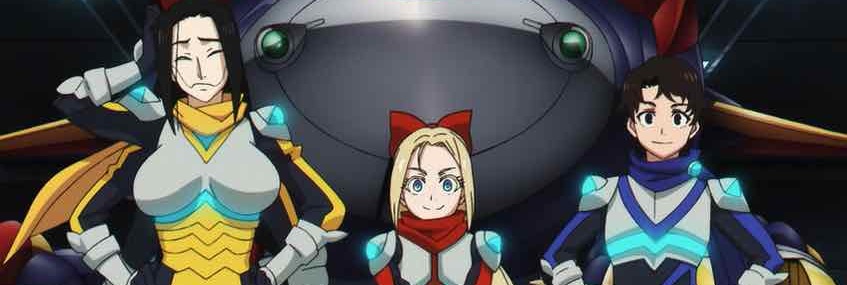
The special ending features Dara-san, Hinata, and Kaoru piloting the supposedly invincible robot Gun Valsey, while several other characters from Reiwa no Dara-san appear in roles inspired by classic robot-anime archetypes.
Adding even more authenticity to the parody is the theme song, “Gun Valsey’s Theme,” performed by veteran anime-song singer Masaaki Endoh. Endoh is particularly well known for his work on major super-robot anime, including The King of Braves GaoGaiGar.
The result is a playful tribute to the dramatic opening and ending sequences of classic Japanese robot anime, while simultaneously fitting perfectly into the unusual comedy of Reiwa no Dara-san.
Episode 6 Turns ‘Gun Valsey’ Into a Full-Fledged Mecha Tribute
One of the most entertaining aspects of Reiwa no Dara-san is its ability to suddenly shift between horror, comedy, everyday life and references to Japanese pop culture.
Episode 6 takes that approach even further.
The fictional robot anime “Gekikou Burai!! Gun Valsey” has appeared as part of the original manga’s world, but the anime adaptation goes a step further by creating a full special ending around the concept.
Rather than simply showing a few humorous images, the sequence is designed to resemble a genuine classic super-robot production.
Dara-san, Hinata and Kaoru are presented as heroic pilots, while Gun Valsey is portrayed as an overwhelmingly powerful giant robot.
The exaggerated poses, mechanical designs, dramatic composition and energetic presentation deliberately evoke the visual language associated with classic Japanese mecha anime.
For viewers familiar with older super-robot series, the sequence becomes an especially fun collection of references.
At the same time, newcomers do not need to understand every reference to enjoy it. The exaggerated seriousness of the presentation itself provides much of the comedy.
A Special Ending Packed With Familiar Characters
The special ending does not focus only on the three central characters.
Several other members of the cast appear in mecha-anime-inspired roles, including Naomichi Fudeki, Miwa Isobe, Shu, and Chiya.
Their appearances help make the sequence feel like a miniature fictional anime rather than a simple parody clip.
The contrast is particularly amusing because these are characters from an occult comedy suddenly being presented with the dramatic seriousness normally reserved for the heroes and supporting characters of a giant-robot series.
The sequence also allows the staff to showcase Gun Valsey’s mechanical design and action in a way that would be difficult to fit naturally into the main story.
This makes the special ending more than a joke.
It functions as a short celebration of the classic robot-anime genre.
Veteran Mecha Animators Join the Production
Another reason the special ending has attracted attention is the impressive group of animators involved in its production.
Taiga Hiroyuki handled the joint storyboards and design work, while Yu Yoshiyama worked on the joint storyboards and mechanical animation supervision.
Several experienced animators with backgrounds in robot anime also participated in the key animation, including:
- Masahito Yamashita
- Kazuaki Mori
- Toru Yoshida
- Hirotoshi Sano
- Masami Obari
Their participation gives the special sequence an additional layer of authenticity.
Rather than simply drawing the characters in robot-anime poses, the production team has clearly embraced the visual language and animation style associated with the genre.
For fans of mecha animation, identifying the stylistic touches contributed by veteran animators may be part of the fun.
Masaaki Endoh Provides the Perfect Super-Robot Voice
The choice of Masaaki Endoh to perform “Gun Valsey’s Theme” is arguably one of the biggest highlights of the special ending.
Endoh is one of the most recognizable voices in Japanese anime music, particularly among fans of super-robot and action series.
He is famously associated with songs such as “Yuusha-Oh Tanjou!”, the opening theme of The King of Braves GaoGaiGar.
That background makes him an ideal choice for a fictional robot anime theme.
The song deliberately embraces the dramatic energy associated with classic super-robot themes, giving the fictional Gun Valsey a surprisingly convincing sense of grandeur.
The lyrics were written by Haruomi Tomotsuka, the original creator of Reiwa no Dara-san, just as they were for the fictional song in the manga.
The song was also made available for digital download beginning August 7, 2026, allowing fans to enjoy the track outside the episode.
What Is ‘Gun Valsey’?
For newcomers, Gun Valsey is not a separate anime series.
It is a fictional robot anime that exists within the world of Reiwa no Dara-san.
The manga uses the fictional show as one of its many pop-culture jokes, and the anime adaptation has now expanded the idea into an actual animated sequence.
This is an increasingly common but particularly entertaining type of anime gag: a fictional work inside a story is given enough detail that it feels as though it could actually exist.
The Reiwa no Dara-san production team takes that concept seriously enough to create character designs, mecha animation, storyboards, and a dedicated theme song.
That level of commitment is precisely what makes the joke work.
‘Reiwa no Dara-san’ Balances Horror and Comedy
The special ending is also a good example of what makes Reiwa no Dara-san different from a conventional supernatural comedy.
The series is based on the occult-comedy manga by Haruomi Tomotsuka.
The story centers on siblings Hinata and Kaoru, who live in the rural community of Mitokitani.
One day, they enter a forbidden area that has long been feared by the local population.
There, they encounter Yamatagi Madara, a half-human, half-snake supernatural being who has been worshipped as a local deity.
Despite his frightening appearance and reputation, the siblings quickly become comfortable around him.
Instead of treating him like a terrifying monster, they affectionately call him “Dara-san.”
Dara-san himself is surprisingly calm, rational, and accustomed to modern life.
This creates the series’ central comedic contrast.
The creature who should be the source of horror frequently ends up becoming the straight man surrounded by the unpredictable behavior of the siblings.
The official introduction similarly describes the series as a new type of occult comedy, combining Dara-san’s tragic past with the chaotic daily life created by the siblings.
Episode 6 Shows Just How Wide the Anime’s Range Can Be
The sixth episode is particularly notable because it combines some of the darker elements of Dara-san’s history with the playful modern-day humor that defines the series.
That contrast makes the Gun Valsey ending even more effective.
The main story can move into unsettling supernatural territory, while the ending suddenly transforms the same characters into heroes of an imaginary super-robot anime.
The result is intentionally absurd—but also surprisingly polished.
It demonstrates that the production team is willing to experiment with different visual styles instead of treating the ending as a simple recap or credits sequence.
The Original Manga Has Become an Anime With Its Own Identity
Reiwa no Dara-san originally began as a manga by Haruomi Tomotsuka and has been serialized through KADOKAWA’s Kadocomi and Nico Nico Manga platforms.
The anime adaptation is directed by Rihito Suzuki, with animation production handled by Asahi Production.
The main cast includes:
- Dara-san / Yamatagi Madara: Mutsumi Tamura
- Hinata Mitokitani: Minami Tsuda
- Kaoru Mitokitani: Momoka Terasawa
- Narrator: Masaki Terasoma
The official anime information also lists additional cast members including Aoi Koga, Tomokazu Sugita, Saori Hayami, Mai Aizawa and Fumihiko Tachiki.
A Correction About the Anime’s Regular Ending Theme
One important detail is worth clarifying.
Although “Gun Valsey’s Theme” is used for the special Episode 6 ending, it should not be confused with the anime’s regular ending theme.
The official Reiwa no Dara-san website lists REIRIE’s “Hinata-bokko” as the series’ regular ending theme.
Therefore, “Gun Valsey’s Theme” is best described as a special ending song associated with the Episode 6 sequence, rather than the anime’s standard ED.
This distinction makes the Episode 6 production even more interesting: the staff effectively created a special musical and visual tribute specifically for the fictional robot anime.
‘Gun Valsey’ Is a Love Letter to Classic Mecha Anime
The special sequence works because it understands that classic robot anime are not only about giant machines.
They are also about presentation.
The heroic poses.
The dramatic character introductions.
The powerful theme song.
The imposing robot.
The exaggerated attacks.
The feeling that the fate of the entire world depends on one final battle.
Reiwa no Dara-san takes all those familiar ingredients and places them inside its own bizarre supernatural-comedy universe.
The result is something that longtime anime fans can appreciate on one level while newcomers can simply enjoy as an energetic parody.
What Makes Episode 6 Special?
Episode 6 is a good example of why Reiwa no Dara-san has attracted attention during the Summer 2026 anime season.
The series does not limit itself to one genre.
It can be:
- A supernatural horror story
- A family comedy
- A slice-of-life series
- An occult mystery
- A parody of Japanese pop culture
- And, apparently, a super-robot anime
That flexibility gives the production considerable room for creative surprises.
The Gun Valsey ending is perhaps the clearest example yet.
Rather than simply referencing classic robot anime through dialogue, the production team recreated the entire aesthetic of the genre.
And with Masaaki Endoh providing the theme song and experienced mecha animators contributing to the sequence, the parody has received an unusually high level of production attention.
Where to Watch ‘Reiwa no Dara-san’
The TV anime “Reiwa no Dara-san” began broadcasting on July 2, 2026, on TOKYO MX and other Japanese television stations. The official website lists TOKYO MX at 22:30, with additional broadcasts on Kansai TV, BS Nippon Television, and AT-X.
The series is also being distributed through various streaming platforms, including d Anime Store and other services.
As the Summer 2026 season continues, viewers can expect the series to keep mixing its supernatural story with unexpected comedy and pop-culture references.
‘Reiwa no Dara-san’ Episode 6: A Surprisingly Convincing Robot Anime
The special “Gun Valsey” ending may only be a short sequence, but the amount of effort behind it makes it one of the most memorable surprises of Episode 6.
What begins as a fictional robot anime joke from the manga has been transformed into a convincing retro-style mecha sequence complete with heroic characters, dramatic mechanical animation, experienced animators, and a theme song performed by one of Japan’s most recognizable anime-song singers.
For fans of classic super-robot anime, it is a fun homage.
For fans of Reiwa no Dara-san, it is another example of the show’s willingness to turn even its smallest jokes into elaborate productions.
And for newcomers, it offers a perfect introduction to the series’ unusual sense of humor.
“Reiwa no Dara-san” may be an occult comedy at heart, but Episode 6 proves that when this series decides to become a giant-robot anime for a few minutes, it is willing to go all the way.