 by
by From “distant history” to a story that feels painfully human
For many people living in peaceful Japan today, war can feel like something that belongs to a distant past.
The Second World War ended more than 80 years ago. For younger generations, the people who directly experienced the conflict are becoming fewer, while memories of wartime Japan are increasingly passed down through books, photographs, museums, documentaries, manga and films.
Yet understanding war through historical records is different from imagining what it meant for an ordinary person trapped inside it.
It is difficult to truly imagine what it feels like to hear explosions nearby, run out of food and water, lose someone you love or realize that the place you once considered home has become a battlefield.
That gap between historical knowledge and human experience is one of the reasons war-themed anime and manga continue to have an important place in Japanese popular culture.
Over the decades, creators who were born after the war have repeatedly attempted to approach the subject from their own perspective. They did not personally experience the battles they depict, but they inherited memories, testimonies, and historical records from earlier generations.
Among the newest examples is “Peleliu: Guernica of Paradise”, an animated film based on the manga by Kazuyoshi Takeda.
Rather than presenting war as a distant historical event filled only with military strategies and famous battles, Peleliu focuses on ordinary young soldiers and the friendships, fears, and dreams that survive even in the middle of a devastating conflict.
The result is a work that asks a difficult but important question:
How can someone who did not experience war personally tell a truthful story about it?
Peleliu: Guernica of Paradise A War Story Told Through Ordinary Soldiers
Peleliu: Guernica of Paradise is based on Takeda’s manga, which was serialized in Young Animal from 2016 to 2021 and collected into 11 volumes. A separate side-story series, Peleliu Gaiden, was later serialized and concluded in 2025.
The animated film was released theatrically in Japan on December 5, 2025, with animation produced by Shin-Ei Animation and Fugaku and directed by Gorō Kuji. The film has a runtime of approximately 106 minutes.
The movie follows Private Hiroshi Tamaru, a young Japanese soldier stationed on Peleliu Island during the Pacific War.
Tamaru has a dream that seems almost completely unrelated to the battlefield.
He wants to become a manga artist.
That detail is important because Tamaru is not introduced as an unstoppable warrior or a heroic military commander.
He is an ordinary young man with an ordinary dream.
The war has interrupted his future.
Instead of thinking about his next manga, however, he is forced to think about survival.
The island that initially appears almost like a tropical paradise gradually becomes a terrifying battlefield.
This contrast between beautiful surroundings and horrific violence lies at the heart of the story.
A Paradise That Becomes a Battlefield
Peleliu Island was the site of the Battle of Peleliu, a major battle of the Pacific War in 1944.
The location is particularly striking because of its tropical environment.
Beautiful beaches, blue skies and lush vegetation create an almost peaceful image.
But beneath that scenery is a history of extreme violence.
The film uses this contrast to make its central message even more powerful.
Instead of beginning with a visually dark and obviously frightening environment, the story places its characters in a setting that can look beautiful.
The viewer is then forced to confront the reality that even a place that resembles paradise can become a battlefield.
This is one reason the title “Guernica of Paradise” is so effective.
The word “paradise” evokes beauty and peace, while “Guernica” recalls one of the most famous symbols of the devastation caused by war.
The contradiction between those ideas reflects the experience of the characters themselves.
The Unique Visual Style of Peleliu
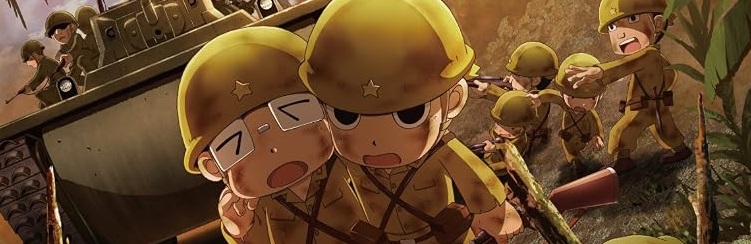
One of the most noticeable characteristics of Peleliu: Guernica of Paradise is its character design.
The characters have a relatively simple, rounded, and sometimes almost cute appearance.
At first glance, this may seem unusual for a serious war drama.
However, that visual approach serves an important purpose.
The characters look like ordinary young people rather than frightening soldiers.
Their simplified designs allow the audience to focus more closely on their expressions, relationships, and emotions.
The contrast becomes particularly powerful when these characters are placed inside scenes of violence and destruction.
The visual language essentially creates two opposing feelings:
The characters look innocent.
The world around them is not.
This contrast can make the brutality of the situation feel even more disturbing.
Instead of relying entirely on realistic military imagery, the film uses stylization to emphasize the emotional experience of the soldiers.
The Difficult Question Behind the Manga
One of the most compelling aspects of Takeda’s work is the creator’s own concern about whether he had the right to depict war.
Takeda was born in 1975, decades after the Second World War ended.
He therefore did not have firsthand experience of the conflict.
That created an obvious problem.
How can someone who has never experienced war portray it honestly?
Rather than ignoring that question, Takeda approached the subject through research.
He studied the Battle of Peleliu and sought out people connected to the island and its history.
He also listened to accounts from veterans.
At the same time, not everyone was willing to share their experiences.
Some survivors believed that the reality of fighting on Peleliu could only truly be understood by those who had been there.
That response illustrates one of the central difficulties of creating historical war fiction.
Research can provide dates, locations, weapons and military information.
But it cannot perfectly reproduce what a person felt while experiencing fear, exhaustion and loss.
Why Survivor Testimony Matters
For postwar creators, firsthand testimony has an especially important role.
People who personally experienced the war possess memories that cannot be completely recreated through textbooks.
They remember small details.
What people ate.
How they spoke.
What they were afraid of.
What they missed about home.
What they thought about while waiting for the next attack.
These details may not appear in traditional historical summaries, but they can be essential when trying to understand war from an individual’s perspective.
Peleliu uses this human-scale approach rather than focusing solely on generals, military strategies, or political decisions.
The story is interested in the people who are caught inside those decisions.
Tamaru Is a Soldier, But He Is Also an Artist
Tamaru’s dream of becoming a manga artist is one of the story’s most important elements.
His artistic ambitions remind viewers that the soldiers were people with futures before the war.
They had careers they wanted to pursue.
They had families.
They had friends.
They had hobbies.
They had dreams.
War did not erase those things from their minds.
Instead, it forced those dreams into the background.
Tamaru’s desire to create manga becomes a symbol of the peaceful life he hopes to return to.
That makes the battlefield feel even more tragic.
The question is not simply whether Tamaru will survive.
It is whether he will ever get the chance to become the person he wanted to be.
Friendship at the Center of the Story
Although Peleliu is a war story, it is not simply about combat.
Friendship plays an equally important role.
The soldiers depend on each other because they are living in an environment where survival can change from one moment to the next.
Small acts of kindness therefore become extremely meaningful.
A conversation.
Sharing food.
Helping an injured friend.
Remembering home.
Talking about what they will do after the war.
These moments give the characters an identity beyond their uniforms.
The film’s emotional power comes partly from this contrast.
The war keeps trying to reduce the characters to soldiers.
The story keeps reminding us that they are human beings first.
Why the Cute Character Designs Are More Important Than They Look
The simplified character designs may initially make the movie appear less realistic than other war films.
But that is precisely what makes the visual approach interesting.
A realistic design can make a battlefield look like a documentary.
A stylized design can instead make the audience focus on the emotional contradiction.
The characters may have round faces and simple expressions, but they experience hunger, fear, grief, and uncertainty.
That creates an unsettling contrast.
The viewer may initially feel comfortable looking at the characters.
Then the story reminds us what is happening around them.
The effect is similar to the way children’s drawings can sometimes communicate traumatic experiences more powerfully than highly detailed images.
Peleliu Is Not the First Postwar Anime to Confront War
Although Peleliu: Guernica of Paradise is a recent example, Japanese animation has a long history of exploring war and its consequences.
Several landmark works were created by people who belonged to generations that did not necessarily experience every event depicted firsthand.
One of the most famous examples is “Barefoot Gen.”
Based on Keiji Nakazawa’s manga and his own experience of surviving the atomic bombing of Hiroshima, the 1983 anime film follows young Gen and his family during and after the destruction of Hiroshima.
Unlike Peleliu, Barefoot Gen comes from a creator with direct experience of wartime devastation.
That distinction makes the two works interesting to compare.
Barefoot Gen can draw heavily on personal memory.
Peleliu, meanwhile, represents a later generation trying to understand history through research, testimony, and imagination.
Both approaches demonstrate different ways that war memories can survive across generations.
Grave of the Fireflies and the Civilian Experience
Another essential work is “Grave of the Fireflies,” directed by Isao Takahata and released in 1988.
The film follows siblings Seita and Setsuko during the final months of the Second World War, focusing on the consequences of the firebombing of Kobe. The story was based on Akiyuki Nosaka’s 1967 autobiographical short story.
The film is not primarily about soldiers.
Instead, it shows what war does to civilians.
That difference is important.
War anime can approach the same historical period from completely different perspectives:
- Soldiers experiencing combat
- Children experiencing bombing
- Families struggling with hunger
- Survivors rebuilding their lives
- Young people losing their futures
- Artists attempting to preserve memories
Together, these perspectives create a more complete understanding of conflict.
In This Corner of the World and Everyday Life
Another notable example is “In This Corner of the World,” which follows an ordinary young woman living in Hiroshima during wartime.
Rather than immediately presenting war through battles, the story spends considerable time showing everyday life.
Cooking.
Drawing.
Working.
Family relationships.
Neighborhood life.
Then war gradually intrudes upon those ordinary routines.
This approach is important because it demonstrates something easy to forget when looking at historical photographs:
People continued living ordinary lives even while extraordinary events were happening around them.
That idea also resonates with Peleliu.
Tamaru has his own interests and ambitions even though he is surrounded by war.
Animation Can Preserve Memories That Are Disappearing
One reason these works remain relevant is the gradual disappearance of firsthand witnesses.
As more time passes, fewer people who personally experienced the Second World War remain alive.
That means society increasingly depends on recorded testimony, museums, photographs, literature, documentaries and creative works to preserve historical memory.
Anime and manga can contribute to that process.
They cannot replace historical documents or survivor testimony.
However, they can encourage younger audiences to become interested in history.
A viewer may discover Peleliu because they enjoy anime.
After watching it, they may become curious about the actual Battle of Peleliu.
They may search for photographs, read about the Pacific War, or learn more about the people who lived through it.
That ability to create curiosity is one of the strengths of historical fiction.
The Importance of Remembering Both Sides of History
There is also an important distinction between portraying war and glorifying war.
A responsible war story does not have to treat one side as entirely heroic and the other as entirely evil.
Instead, it can show the human consequences of decisions made by governments, militaries,s and political leaders.
Peleliu focuses primarily on Japanese soldiers, but that does not mean the story exists outside the broader historical context.
Understanding the Pacific War requires recognizing the actions and experiences of multiple countries and populations.
That wider context is especially important for modern audiences who are encountering these events decades later.
A war anime can therefore be a starting point for learning history rather than a replacement for historical study.
The 80th Anniversary Context
The timing of Peleliu is also significant.
The film’s Japanese theatrical release came in December 2025, during the period marking the 80th anniversary of the end of the Second World War. The film was subsequently selected for the 2026 Annecy International Animation Film Festival, where it was nominated in the Contrechamp feature-film section.
The film’s continued attention in 2026 shows that interest in historical animation remains strong.
It also demonstrates that war stories do not necessarily become less relevant simply because more time has passed.
In some ways, the opposite can happen.
As direct memories become more distant, new generations may need new ways of connecting with the past.
Peleliu Is Now Available on Netflix
For viewers who want to watch the film, there is also a significant recent update.
The official movie website announced that “Peleliu: Guernica of Paradise” began streaming exclusively on Netflix in Japan on July 19, 2026.
The film is approximately 106 minutes long, making it a relatively accessible entry point for viewers who want to experience a historical war story in a single sitting.
Because the subject matter is serious, however, it is worth approaching the film with the expectation that it contains emotionally difficult material.
It is not a conventional action anime designed primarily around exciting battles.
Its focus is on the people living through those battles.
Why Peleliu Is Worth Watching for Anime Fans
Someone who normally watches fantasy, romance, action, or comedy anime may wonder whether a historical war film like Peleliu is for them.
There are several reasons to give it a chance.
- It tells history through individual characters.
Instead of presenting only dates and facts, it gives the audience people to follow.
- The visual style is distinctive.
The contrast between simple character designs and a brutal setting gives the movie a unique identity.
- It focuses on human relationships
Friendship, fear and hope are just as important as combat.
- It raises questions about memory.y
The film encourages viewers to think about how people born after a war can understand and communicate its reality.
- It can be a gateway to history. ry
Viewers who become interested in the Battle of Peleliu can use the film as a starting point for learning more about the actual historical events.
War Anime Should Not Make War Look Ordinary
Perhaps the most important contribution of works such as Peleliu, Barefoot Gen, and Grave of the Fireflies is their ability to challenge the way war is sometimes presented in entertainment.
In action-oriented stories, battles can become spectacles.
Characters fight.
Weapons explode.
Heroes survive.
Victories are celebrated.
Real war is much more complicated.
People become separated from their families.
Food becomes scarce.
Homes disappear.
Young people are forced into situations they never chose.
And even those who survive may carry the consequences for the rest of their lives.
Historical anime does not always have to show every detail of that reality to make audiences think about it.
Sometimes, showing a character quietly talking about the future is enough.
Because the audience knows that the future they are talking about may never arrive.
A New Generation’s Way of Looking Back
This is perhaps what makes postwar-created war anime particularly interesting.
Creators such as Kazuyoshi Takeda belong to a generation that inherited the memory of war rather than experiencing the conflict themselves.
Their responsibility is different from that of a firsthand witness.
They cannot say, “This is exactly what I experienced.”
Instead, they must say:
“This is what I learned from those who experienced it, and this is how I understand it.”
That process inevitably involves interpretation.
But interpretation does not necessarily make a historical story meaningless.
When handled carefully, it can help keep forgotten stories alive.
Final Thoughts
Peleliu: Guernica of Paradise is more than a war anime.
It is a story about memory, friendship, dreams, and the difficulty of understanding an experience that belongs to another generation.
Its central character, Tamaru, is not defined only by the fact that he is a soldier.
He is a young man who dreams of becoming a manga artist.
He has hopes for the future.
He has friends.
He has fears.
And he is suddenly trapped in a conflict far larger than himself.
That human perspective is what gives the story its emotional power.
The film also belongs to a long tradition of Japanese anime and manga that has attempted to preserve memories of wartime Japan, from Barefoot Gen and Grave of the Fireflies to more recent historical works.
Today, as firsthand memories of the Second World War become increasingly distant, these stories can serve as an entry point for younger audiences to ask questions about the past.
Peleliu: Guernica of Paradise was released in Japanese theaters in December 2025 and began streaming on Netflix in Japan on July 19, 2026. It was also nominated for the 2026 Annecy International Animation Film Festival’s Contrechamp feature-film competition.
For anime fans looking for a serious historical film—and for anyone interested in how modern creators portray the human cost of war—Peleliu: Guernica of Paradise offers a powerful place to begin.
The film does not make the past feel comfortable.
And perhaps that is exactly why stories like this continue to matter.