 by
by The live-action adaptation of Tatsuki Fujimoto’s Look Back has revealed a closer look at one of its most distinctive filmmaking techniques.
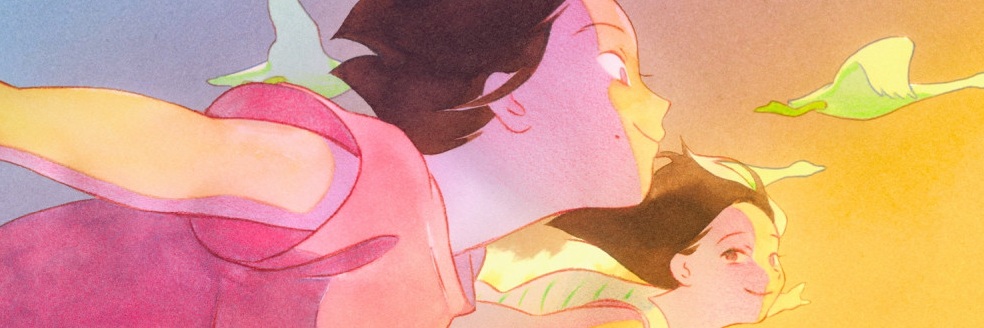
Four new still images from the movie’s rotoscoped animation sequence have been unveiled, offering fans their first detailed look at the hand-crafted animated material incorporated into Hirokazu Kore-eda’s live-action adaptation. Alongside the images, a conversation between Fujimoto and animation director Yōko Kuno has also been released, revealing how the unusual sequence was created and how the two artists’ careers unexpectedly crossed years before they worked together on the film.
The new material is particularly interesting because Look Back is not itself an animated movie. The 2026 version is a live-action feature film, directed, written, and edited by acclaimed filmmaker Hirokazu Kore-eda. The movie opened in Japan on September 11, 2026, following its world premiere in competition at the 83rd Venice International Film Festival.
The film stars Natsuki Deguchi as Fujino and Aju Makita as Kyomoto, following the two girls over approximately 13 years as their shared passion for drawing manga brings them together and changes both of their lives.
The newly revealed animation sequence adds another artistic layer to their story, connecting Fujimoto’s original manga drawings, the live-action performances, and the characters’ dream of seeing their drawings come alive.
Look Back Is a Live-Action Film, Not an Animated Movie
One important clarification is necessary for readers who may be encountering this project for the first time.
The new Look Back movie is not a remake of the 2024 anime film and is not primarily an animated production.
It is a live-action adaptation of Fujimoto’s one-shot manga, with real actors portraying Fujino and Kyomoto. However, Kore-eda’s film incorporates an animated sequence created using rotoscoping, a technique in which animation is developed from live-action footage.
This makes the film especially unusual because it moves between different artistic forms rather than relying on one visual style throughout.
The 2026 movie is the second major screen adaptation of Fujimoto’s Look Back. The first was the acclaimed 2024 anime film, directed by Kiyotaka Oshiyama and produced by Studio Durian. The new live-action version approaches the same source material from a completely different cinematic perspective.
Four New Stills Reveal the Rotoscope Animation
The newly released images show Fujino and Kyomoto in animated form against backgrounds including the sea, sky, and scenery viewed from a car window.
Rather than simply reproducing Fujimoto’s original manga art, the animation attempts to find a visual middle ground between the real actors and the creator’s drawing style.
This was one of the most important challenges for the animation team.
The filmmakers wanted the sequence to feel connected to the live-action movie while also reflecting the hand-drawn quality that is central to Look Back.
As a result, details associated with Fujimoto’s character designs were incorporated into the animation, while watercolor and colored-pencil textures helped preserve the feeling of something created by hand.
The result is intended to feel less like a conventional computer-generated animated sequence and more like Fujino and Kyomoto’s drawings have actually begun to move.
What Is Rotoscope Animation?
For viewers unfamiliar with the technique, rotoscoping is an animation method in which artists use live-action footage as a reference and redraw the movement frame by frame.
Instead of inventing every movement entirely from scratch, animators study the recorded performance and translate it into drawings.
This can preserve subtle movements that are difficult to reproduce through traditional animation alone.
For Look Back, the technique has an additional thematic meaning.
Fujino and Kyomoto are artists who dream about creating manga and eventually seeing their drawings come alive. The film’s rotoscope sequence therefore connects the characters’ artistic ambitions with the filmmaking process itself.
The audience is effectively watching real performances transformed into drawings—the same kind of transformation that Fujino and Kyomoto dream about in the story.
Hirokazu Kore-eda Explains Why the Animation Was Added
Kore-eda discussed the purpose of the animated sequence in a conversation with Fujimoto included in the movie’s theatrical pamphlet.
He explained that when Fujino eventually returns to her workplace and picks up her pen, he thought about the emotional burden she would be carrying.
Rather than presenting only sadness, Kore-eda wanted the moment to communicate a sense of moving forward.
His idea was that memories of Fujino and Kyomoto discussing their dream of turning their work into anime would return to Fujino. Kyomoto’s drawings would then appear to come alive, allowing the characters to exist together again within the artwork.
In other words, the animation is not simply an aesthetic experiment.
It is connected to the film’s emotional themes of memory, creativity, friendship, loss, and continuing to create after experiencing grief.
Tatsuki Fujimoto Was Moved by the Finished Animation
Fujimoto also praised the completed sequence.
The Chainsaw Man creator said that simply watching the animation section by itself was deeply moving for him and expressed confidence that audiences would also find the sequence emotional.
He further praised the film for communicating its message even without requiring viewers to know every detail surrounding the story.
That reaction is especially meaningful because Look Back is a deeply personal story about two creators whose lives become connected through art.
Fujimoto’s response also demonstrates how closely the live-action film’s new material attempts to connect with the emotional core of his original manga.
The Animation Was Almost Made Digitally
According to Yōko Kuno, the production team initially considered using digital coloring for the animated material.
However, Kore-eda wanted to preserve the visual nuances associated with watercolors and colored pencils.
That request significantly influenced the final production process.
Rather than creating a completely digital-looking sequence, the team searched for a visual middle ground between the real actors and Fujimoto’s drawings.
Kuno explained that they incorporated characteristic elements from Fujimoto’s artwork, including facial details such as the shape and appearance of the characters’ under-eye areas.
The goal was not to copy Fujimoto’s drawings exactly.
Instead, the team wanted the animation to feel as though the live-action characters were gradually being transformed into something that could exist inside Fujimoto’s artistic world.
Around 10 Animators Colored the Frames by Hand
Perhaps the most surprising behind-the-scenes detail is how much of the coloring was done manually.
The production team first created the line art digitally.
Those drawings were then printed onto paper.
From there, approximately 10 Shin-Ei Animation staff members worked on the printed frames, adding lines with colored pencils and applying paint by hand.
This meant that individual frames received physical, handmade treatment rather than being completed entirely through digital coloring.
Kuno described the process as an unusually generous use of time because there was enough production time allocated to these short sections to allow the artists to work carefully on individual frames.
The approach is particularly appropriate for Look Back, a story in which the physical act of drawing is central to the characters’ identities.
Shin-Ei Animation Produced the Animated Sequence
The rotoscoped material was directed by Yōko Kuno, with Shin-Ei Animation handling the animation production.
Shin-Ei Animation is known for a wide range of Japanese animated productions, making its involvement an interesting bridge between the live-action filmmaking of Kore-eda and the animation world associated with Fujimoto’s original story.
The sequence therefore combines several creative approaches:
- Live-action performances
- Rotoscope animation
- Digital line art
- Hand-drawn colored-pencil work
- Painted textures
- Fujimoto-inspired character details
- Live-action cinematography
This combination helps distinguish the new Look Back from both the original manga and the 2024 anime adaptation.
Fujimoto and Kuno Have a Surprisingly Similar Story
The conversation between Fujimoto and Kuno also revealed an unexpected personal connection.
When Kuno was selected to participate in the Look Back project, she received a message from Fujimoto himself on X.
For Kuno, the experience immediately reminded her of the relationship between Fujino and Kyomoto.
From her perspective, Fujimoto was an established manga creator whose world seemed very different from her own. Then, suddenly, she received a direct message from him.
The experience made her feel, in her own words, somewhat like Fujino when she first encountered Kyomoto’s work.
The comparison is particularly fitting because Look Back is fundamentally a story about how one creator’s work can unexpectedly inspire another person.
In this case, the same kind of creative connection happened outside the story as well.
Fujimoto Says Kuno’s Graduation Project Shocked Him
The connection goes even further.
Fujimoto revealed that he had previously encountered Kuno’s graduation project, Airy Me, and was deeply affected by it.
He described Kuno’s work as something that could have a major impact on art students who encounter it while researching graduation projects.
According to Fujimoto, seeing Kuno’s work left him overwhelmed.
Rather than discouraging him permanently, however, the experience helped push him toward manga.
In discussing the effect Kuno’s graduation project had on him, Fujimoto explained that he too had been overwhelmed by Airy Me and ultimately decided that he would pursue drawing manga.
This makes their collaboration on Look Back particularly fitting: an artist whose work once influenced Fujimoto eventually became part of a film adaptation of Fujimoto’s own manga.
What Is Airy Me?
Airy Me is an animated graduation project associated with Kuno’s time as an art student.
The work is notable for its distinctive visual atmosphere and experimental approach to animation, which helped establish Kuno’s reputation as an animator with a highly individual artistic style.
For Fujimoto, encountering that project became part of his own creative journey.
Years later, Kuno’s animation style would become part of the live-action adaptation of one of Fujimoto’s most personal manga works.
That creative circle is one of the most fascinating behind-the-scenes stories surrounding the new movie.
Yōko Kuno Analyzed Fujimoto’s Characters
During their conversation, Kuno also discussed what she sees in Fujimoto’s characters.
She described them as possessing a kind of childlike quality.
However, she did not mean that they are simply innocent or cheerful.
Instead, Kuno explained that Fujimoto’s characters can combine straightforward affection with a certain cruelty or malice associated with childhood.
That combination can make his characters feel unpredictable.
They can love something intensely while also behaving in ways that adults might find difficult to understand.
Kuno suggested that this contradiction is part of the special quality she sees in Fujimoto’s work.
Her comments are particularly relevant to Look Back, where Fujino and Kyomoto’s relationship begins with admiration, competition, jealousy, inspiration, and eventually a deep creative bond.
Fujimoto’s Characters Are Not Always Completely Explained
Fujimoto responded that he does not necessarily believe every missing or incomplete part of a person needs to be “fixed.”
That idea may explain why some of his characters feel unfinished or difficult to fully understand.
Rather than explaining every motivation, Fujimoto often allows parts of a character to remain ambiguous.
For readers and viewers, this creates space to interpret the characters independently.
It also contributes to the emotional quality of Look Back, where the audience is encouraged to think about the characters’ feelings rather than receiving an explanation for every moment.
Look Back Follows 13 Years of Fujino and Kyomoto’s Lives
At the center of the film are Fujino and Kyomoto, two girls who initially appear to be very different.
Fujino is confident in her drawing ability and enjoys recognition from other people.
Kyomoto, meanwhile, is a reclusive girl who spends much of her time drawing alone.
Their relationship begins through manga.
When Fujino discovers Kyomoto’s impressive artwork, she is initially affected by the realization that someone her age may be better at drawing than she is.
That rivalry eventually develops into a friendship and creative partnership.
As the years pass, their relationship changes, and the story explores what happens when people who once shared the same dream begin moving through life in different directions.
The film follows their journey across approximately 13 years, making it as much a coming-of-age story as it is a story about manga creation.
Natsuki Deguchi and Aju Makita Lead the Film
Natsuki Deguchi plays Fujino, while Aju Makita plays Kyomoto.
The younger versions of the characters are portrayed by Fūri Nanase as young Fujino and Rokka Okada as young Kyomoto.
The casting allows the movie to portray the characters at different stages of their lives while maintaining the central contrast between Fujino’s outgoing personality and Kyomoto’s more withdrawn nature.
The cast also includes performers such as Kankurō Kudō and Masaki Suda, alongside supporting cast members who expand the world surrounding Fujino and Kyomoto.
The Film Was Shot on 35mm Film.
Another distinctive aspect of Kore-eda’s adaptation is its cinematography.
The entire movie was shot on 35mm film, following Kore-eda’s preference for analog filmmaking.
Cinematographer Senzo Ueno worked with Kore-eda to capture the characters and the changing landscapes surrounding them.
The production was primarily filmed in Nikaho City, Akita Prefecture, and the filmmakers deliberately captured different seasons, including winter, spring, summer, and autumn.
This gives the passage of time a physical presence in the movie.
The changing landscapes mirror the characters’ own growth as they move from childhood toward adulthood.
Nikaho City Became an Important Part of the Production
The movie was filmed primarily in Nikaho, a city in Akita Prefecture.
Residents also supported the production, and the surrounding scenery became an important part of the film’s visual identity.
The use of real locations helps the movie maintain a grounded atmosphere even when the story eventually moves into more imaginative territory through the rotoscope sequence.
TDK also provided special cooperation for the production, including support connected to filming in Nikaho City.
Kenshi Yonezu Also Joins the Film
Another notable creative connection involves Kenshi Yonezu, who has previously worked on adaptations of Fujimoto’s works.
Yonezu appears in the film as “Shark Kick Guitar,” performing guitar for a scene.
His connection to Fujimoto’s work is already well established through “KICK BACK,” the opening theme of the Chainsaw Man television anime, and his later involvement with Chainsaw Man – The Movie: Reze Arc.
The Look Back project therefore brings together several artists who have previously worked within Fujimoto’s creative universe.
Tōko Miura Contributes Vocals
Tōko Miura also contributes vocals to an insert song used in the film.
Her participation adds another musical layer to the adaptation, with composer Yūta Bandoh handling the film’s music.
The soundtrack was released in Japan on September 12, 2026, shortly after the film’s theatrical release.
Look Back Premiered at the Venice International Film Festival
Before its Japanese theatrical release, the live-action Look Back premiered internationally at the 83rd Venice International Film Festival.
The movie was selected for the festival’s Competition section, placing Kore-eda’s adaptation among the films competing at one of the world’s major international film festivals.
The Venice premiere was an important milestone because it introduced Fujimoto’s story and Kore-eda’s adaptation to an international cinema audience before the movie opened in Japan.
The Film Opened in Japan on September 11
Following its Venice premiere, Look Back opened in Japanese theaters on September 11, 2026.
The movie is produced and distributed in Japan by K2 Pictures.
For international audiences, GKIDS acquired theatrical distribution rights for the United States, Canada, the United Kingdom, and Ireland, with the international release to follow. An exact release date for those territories had not been announced in the latest information available.
Look Back Has Now Been Adapted Three Ways
For beginners, it is useful to understand that there are now three major versions of Look Back:
- The Original Manga
Tatsuki Fujimoto’s one-shot manga was published through Shueisha’s Shonen Jump+ in 2021.
It quickly attracted significant attention because of its emotional story and themes surrounding creativity, friendship, loss, and artistic ambition.
- The 2024 Anime Film
The manga was adapted into a theatrical anime film directed by Kiyotaka Oshiyama and produced by Studio Durian.
The animated version is approximately one hour long and uses Fujimoto’s artwork as the foundation for its visual style.
- The 2026 Live-Action Film
Hirokazu Kore-eda’s version transforms the same story into a live-action feature while adding new cinematic elements, including the rotoscoped animation sequence.
This means newcomers can experience the same core story through three different artistic interpretations.
Why the New Animation Matters
The rotoscoped sequence is more than a technical experiment.
Look Back is a story about drawing, so transforming live-action performances into hand-drawn animation creates a direct connection between the movie’s filmmaking technique and its subject matter.
Fujino and Kyomoto dream about making pictures that move.
The filmmakers literally make their performances move as drawings.
This creates a connection between the characters’ imagination and the filmmaking process itself.
It also helps distinguish Kore-eda’s adaptation from the 2024 anime.
Rather than simply recreating the anime’s visual style, the live-action film develops its own language for showing how art, memory, and imagination overlap.
Why the Fujimoto and Kuno Connection Is So Meaningful
The most fascinating part of the latest behind-the-scenes material may be the connection between Fujimoto and Kuno themselves.
Years before Kuno worked on Look Back, Fujimoto encountered her graduation project Airy Me and was deeply affected by it.
Later, when Kuno received a message from Fujimoto about joining the project, she experienced a moment that reminded her of the relationship between Fujino and Kyomoto.
That creates a real-world parallel to the story.
In Look Back, two artists discover each other through their work.
In reality, Fujimoto and Kuno also encountered each other’s creative work and eventually collaborated.
The film’s themes therefore extend beyond the fictional relationship between its two protagonists.
The latest behind-the-scenes material from Hirokazu Kore-eda’s live-action Look Back offers a fascinating look at how the film attempts to translate Tatsuki Fujimoto’s manga into another medium.
The newly revealed four stills showcase the film’s rotoscoped animation sequence, while the conversation between Fujimoto and Yōko Kuno explains how the unusual visuals were created.
The production process is particularly striking. Digital line art was printed onto paper, after which around 10 Shin-Ei Animation staff members added colored-pencil lines and paint by hand. The decision to preserve watercolor and colored-pencil textures came from Kore-eda’s desire to retain the handmade feeling associated with Fujimoto’s drawings.
The collaboration is also meaningful on a personal level.
Fujimoto revealed that Kuno’s graduation project Airy Me once left him overwhelmed and contributed to his decision to pursue manga. Years later, Kuno received a direct message from Fujimoto and eventually became responsible for one of the most distinctive sequences in the live-action adaptation of his work.
That real-life creative connection feels remarkably close to the central idea of Look Back: one artist can discover another artist’s work, be changed by it, and eventually create something together.
With the film now playing in Japanese theaters and international theatrical releases still to come in several territories, Look Back continues to expand the life of Fujimoto’s one-shot manga through a new combination of live-action cinema and hand-crafted animation.