 by
by What does childhood look like when you remember it 30 years later?
That question lies at the heart of We Are Aliens, the upcoming Japanese-French animated feature directed by Kohei Kadowaki.
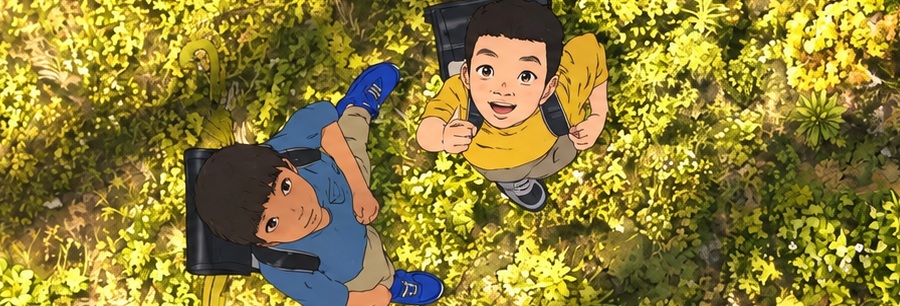
The film follows two boys, Tsubasa, a quiet child who struggles with being “ordinary,” and Akitaro, a popular classmate regarded as someone “special.” Their friendship begins in a rural Japanese town during the Heisei era, but an irreversible incident eventually changes their relationship and leaves memories that continue to affect them decades later.
Kadowaki’s feature-length directorial debut has already attracted international attention. We Are Aliens was selected for the Directors’ Fortnight at the 79th Cannes Film Festival and later entered the Feature Film Competition at the 2026 Annecy International Animation Film Festival. The film is now preparing for its Japanese theatrical release on September 25, 2026.
What makes the project particularly interesting is that Kadowaki did not come to feature filmmaking through the conventional television-anime route. Born in 1996, he graduated from the Department of Design at Tokyo University of the Arts, worked at an animation production company, and later became independent. He has worked on stage visuals, commercials,s and animation-based music videos, including YOASOBI’s “Comet” music video.
In a detailed interview, Kadowaki discussed how he transformed personal memories into a feature film, why he was obsessed with the emotional rhythm of storytelling, how rotoscoping helped him capture realistic childhood movement, and how influences ranging from Doraemon and Studio Ghibli to Naruto and 1980s live-action cinema shaped his creative instincts.
From Childhood Memories to a Feature Film
Kadowaki says the original idea for We Are Aliens existed in his mind long before there was a finished story.
When he was in his early twenties, he began thinking about how he could leave a lasting record of his childhood.
He did not initially have a complete screenplay or even a clearly defined plot. Instead, he had fragments—images, memories, and feelings that he wanted to preserve through animation.
Because he already worked as an artist, animation felt like the natural medium.
The project began taking concrete shape after he met producer Hayashi several years later. The two began discussing the possibility of creating a feature film, giving Kadowaki an opportunity to turn those scattered memories into a structured story.
The challenge was figuring out how to transform memories into something that could hold an audience’s attention for nearly two hours.
Kadowaki realized that simply collecting nostalgic scenes would not be enough.
He needed a story that moved through different emotional stages.
That became the foundation of We Are Aliens.
Building the Story Around an Emotional Turning Point
Rather than beginning with a conventional chronological outline, Kadowaki started by identifying a major event in the middle of the story.
That event became the central turning point from which the rest of the screenplay developed.
He then worked backward and forward, dividing the story into larger dramatic movements and eventually breaking those movements down into smaller sequences.
He describes the process as creating a series of beginnings, developments, climaxes, es and conclusions.
The same principle was applied to the childhood sections.
Instead of treating the protagonists’ childhood as one long flashback, the story was constructed from smaller episodes that gradually build their friendship and establish the emotional importance of the memories they share.
This structure allowed the film to move naturally between intimate childhood moments and the larger emotional consequences of what happens later.
Why Kadowaki Focused on “Waves of Emotion”
One of the most interesting parts of Kadowaki’s approach is his emphasis on emotional rhythm.
During the early stages of production, he realized that a two-hour animated film cannot depend entirely on visually impressive scenes.
Even beautiful animation can become tiring if the emotional intensity remains at the same level for too long.
Kadowaki compared storytelling to a roller coaster.
If a roller coaster only moves quickly, the experience eventually becomes monotonous. The ride needs moments when it slows down, rises, pauses, and then suddenly accelerates.
He wanted the same principle to apply to the film.
A quiet scene should be allowed to breathe before a major emotional moment. A tense sequence can become more effective when it follows something calm. A joyful memory can feel more meaningful when the audience knows that something painful may eventually happen.
This became one of the most important principles behind the screenplay.
Spirited Away Was Another Reference Point
Kadowaki also studied how other filmmakers created emotional acceleration.
One example he specifically considered was Spirited Away, particularly a sequence in which Chihiro nervously descends a staircase before suddenly losing her balance and accelerating.
For Kadowaki, the important lesson was not simply the animation itself.
It was the way a scene can change its emotional speed almost instantly.
He watched a wide range of films to understand how directors created these emotional “roller coasters,” then applied those observations to the screenplay of We Are Aliens.
The result is a film designed around the audience’s emotional experience rather than simply around a sequence of visually impressive images.
How Much of the Story Comes From Kadowaki’s Own Life?
Although We Are Aliens is not a direct autobiography, Kadowaki says approximately 20 to 30 percent of the film comes from his own experiences.
One example is the story’s first-love episode.
Some of the experiences shown on screen are therefore rooted in memories from Kadowaki’s own youth.
However, he did not simply reproduce his childhood.
Instead, he used personal memories as raw material and transformed them into fictional characters, situations and relationships.
This distinction is important.
The film is about memories, but it is not simply a diary.
It asks what happens when ordinary childhood moments remain inside us for decades—and whether the memories we carry are necessarily the same as the experiences other people remember.
Nostalgia Is Built Into the Smallest Details
The film’s nostalgic feeling does not come only from its story.
Kadowaki paid enormous attention to objects and environments.
A school bag might have a particular type of damage.
A school desk might have worn corners.
A classroom might contain tiny details that viewers remember from their own childhood.
These objects may appear insignificant, but Kadowaki believes they can act as nostalgia triggers.
The goal was not to make every viewer remember the same childhood.
Instead, he wanted each person to discover something that reminded them of their own past.
Someone might notice an old school item.
Another viewer might recognize the shape of a classroom window.
Someone else might remember the way children ran down a road at sunset.
By filling the world with these small details, We Are Aliens creates space for the audience’s own memories to become part of the viewing experience.
Why the Visuals Are So Detailed
This attention to detail also explains why We Are Aliens has such a distinctive visual style.
Kadowaki says the film’s realistic appearance developed naturally from the amount of information he believed was necessary to make the story work.
If the film was supposed to make viewers feel that they had returned to childhood, then the environment needed enough detail to feel lived-in.
That meant paying attention to backgrounds, props, clothing, buildings, school furniture and everyday objects.
The result is a visual world that is much more detailed than a simplified cartoon style.
Yet Kadowaki does not consider this approach completely separate from his own artistic identity.
He describes it as an evolution of his existing drawing style.
He has always been someone who enjoys drawing detailed images and carefully thinking about what he wants to show.
For him, the visual style of We Are Aliens therefore represents the latest development of an artistic instinct that was already present in his earlier work.
Characters and Backgrounds Were Designed to Belong to the Same World
One challenge of highly detailed animation is keeping the characters from looking disconnected from their environments.
A character with a very simplified design can sometimes look strange when placed against an extremely realistic background.
Kadowaki wanted to avoid that problem.
He therefore paid close attention to the amount of visual information in both characters and backgrounds.
The characters needed enough detail to feel like they belonged inside the world around them.
He also had background artists work with some of the same brushes and visual approaches used for character artwork.
This helped create a unified visual texture.
Kadowaki himself handled several major creative positions, including work connected to art direction, animation direction, editing, and color grading.
He also remained involved in post-production from an early stage.
That level of involvement allowed him to maintain a consistent tone across the film.
Why the Film Looks Like It Was Shot Through a Camera
Another distinctive feature of We Are Aliens is its approach to composition.
Many shots feel as though they were carefully photographed with a real camera.
The framing can make characters appear distant, close,e or compressed depending on the emotional situation.
Kadowaki explained that he naturally thinks about which lens would be appropriate for a shot.
For example, he might first decide how large he wants a sunflower or character to appear within the frame. From there, he considers what kind of lens would create that composition.
This process became so natural to him that he did not initially consider it a distinctive part of his style.
Interestingly, it was during discussions at Cannes that other people pointed out how effectively the film uses wide-angle and telephoto perspectives.
That was when Kadowaki realized that his approach to visual composition had become one of his recognizable artistic characteristics.
Kadowaki’s Interest in Live-Action Cinema Helped
Although We Are Aliens is an animated film, Kadowaki says that around 80 percent of the movies he watches are live-action.
This has influenced the way he thinks about framing, lenses, performances,s and camera movement.
He even purchased a single-lens reflex camera while scouting locations for the film.
Photography became another tool for understanding how the world could be translated into animation.
Instead of simply drawing what he saw, Kadowaki thought about how a real cinematographer might photograph the same scene.
That perspective contributes to the film’s unusually cinematic appearance.
It also helps explain why We Are Aliens can feel different from conventional TV anime.
The film is animated, but its visual language is heavily influenced by live-action filmmaking.
Rotoscoping Helps Capture Realistic Movement
One of the most technically interesting aspects of We Are Aliens is its use of rotoscoping.
Rotoscoping is a technique in which animators use live-action footage as a reference for movement.
It can help artists reproduce subtle physical motions that are difficult to invent entirely from imagination.
For We Are Aliens, the production team filmed reference footage for almost every shot.
This included scenes involving both the characters’ childhood and adulthood.
When time was limited, Kadowaki even performed some scenes himself for reference.
For the childhood sequences, child actors were selected through auditions and asked to perform the scenes.
But Kadowaki did not want to simply trace the footage frame by frame.
That would have created another problem.
Real human movement does not always look the way an animator wants it to look.
Why Rotoscoping Was Not Used Blindly
A child actor may move naturally, but that movement does not necessarily produce the ideal animated image.
Similarly, a person’s proportions can appear different depending on the camera angle.
Kadowaki explained that simply tracing real movement could sometimes produce problems—for example, a child’s movement might not look sufficiently “childlike” once translated directly into animation.
The same applies to body proportions and gestures.
Animation therefore required interpretation.
The team used rotoscoping to capture the core movement, then modified it to create a convincing animated performance.
This created what could be described as a hybrid approach.
Real-world movement provides the foundation, while animation techniques refine clothing, hair, expressions, and body proportions.
Why Children’s “Unnecessary” Movements Matter
One of the biggest advantages of filming child actors was capturing movements that would be difficult for an animator to invent deliberately.
Children rarely move perfectly.
They may run differently from one another.
They may swing their arms unnecessarily.
They may change direction suddenly.
They may fidget or make movements that have no obvious purpose.
Those irregularities can make a character feel more alive.
Kadowaki believes these seemingly unnecessary movements are particularly valuable because they can be difficult to create through traditional drawing.
Instead of removing those imperfections, he used them as a source of realism.
The result is animation that can feel spontaneous rather than mechanically perfect.
Kadowaki Directed the Live-Action Reference Performances
Kadowaki was also directly involved in filming the reference footage.
However, he did not want to control every movement.
When working with children, he found that giving too many detailed instructions could actually remove the natural behavior he wanted to capture.
Instead, he explained the situation and allowed the young performers to react naturally.
That approach gave the animators access to unpredictable movements that could later be incorporated into the film.
It is an example of how the production combines filmmaking techniques from live-action and animation rather than treating the two mediums as completely separate.
Doraemon, Studio Ghibli and Naruto Were Major Influences
When asked about the artists and works that influenced him, Kadowaki gave a surprisingly broad list.
Among his childhood and teenage influences were Doraemon movies, Studio Ghibli films,s and 1980s movies.
In manga, he specifically mentioned Naruto.
These influences help explain the balance in We Are Aliens.
The film is deeply interested in everyday childhood life, but it also understands the appeal of large cinematic adventures.
Doraemon’s movies, for example, often transform ordinary children’s lives into emotional journeys.
Studio Ghibli films similarly demonstrate how small everyday moments can coexist with larger dramatic themes.
Naruto, meanwhile, showed Kadowaki the power of long-term relationships, childhood friendships, and characters struggling with the question of what makes them special.
1980s Movies Were a Family Influence
Kadowaki’s interest in 1980s live-action cinema came partly from his father.
He grew up watching films such as The Terminator and Back to the Future, along with movies starring martial-arts icons such as Jackie Chan and Bruce Lee.
These are very different influences from Doraemon or Studio Ghibli.
Yet they share something important: strong visual storytelling.
Action scenes, physical comedy, character movement,t and memorable cinematic framing all left an impression on Kadowaki.
His own film therefore brings together influences that might initially appear unrelated.
A nostalgic Japanese childhood story can still be shaped by the language of Hollywood science fiction, martial-arts cinema and modern animation.
He Also Looks at Popular Films Around the World
Kadowaki does not limit himself to animation.
He says he often watches popular films from around the world and follows movies that are generating discussion at the time.
He mentioned works such as Parasite and films by Japanese director Hirokazu Kore-eda.
This broad viewing habit has likely contributed to his desire to create a film that is emotionally accessible rather than limited to anime conventions.
“I Wanted the Film to Be Easy to Understand”
One particularly relatable part of the interview is Kadowaki’s comment about accessibility.
He said that when people describe a movie as “difficult to understand,” he often finds himself struggling to follow it as well.
As a result, he deliberately wanted We Are Aliens to be easy to understand.
That does not mean the film lacks emotional complexity.
Instead, Kadowaki wants viewers to understand what the characters are experiencing even when the story deals with painful memories and complicated relationships.
The film can therefore be emotional without requiring viewers to decode an elaborate narrative puzzle.
The Story Is About 30 Years of Friendship
At its center, We Are Aliens is a story about 30 years of friendship.
Tsubasa and Akitaro meet when they are elementary-school students.
Tsubasa is shy and worries about being ordinary, while Akitaro is popular and viewed as someone special.
The two become close friends and develop their own world through games, conversations, ns and walks home after school.
But their relationship changes.
Rumors and social pressure begin to surround Akitaro, gradually making him feel isolated from the rest of the class.
Eventually, an irreversible incident changes the relationship between the two boys.
Decades later, their past still exists beneath the surface.
The film asks whether their story should be understood as a beautiful memory of youth—or as something one of them would rather forget.
The “Alien” Idea Has a Deeper Meaning
The film’s title might initially make audiences expect science fiction.
But We Are Aliens is primarily a coming-of-age drama.
The “alien” idea is connected to the feeling of being different from everyone around you.
A child who feels isolated may imagine that they do not belong in the world around them.
The film uses that feeling to explore friendship, jealousy, loneliness, memory, and the desire to be recognized as something special.
This makes the title work on both a literal and emotional level.
The question “What if I were an alien?” becomes a way for the characters to express feelings they may not know how to describe directly.
The New Theme Song Adds Another Emotional Layer
Ahead of the Japanese theatrical release, the film has also unveiled its theme song “Sasakure” by adieu, the music project of actress and singer Moka Kamishiraishi.
The song was written and composed by Yaffle, who also created the film’s music.
A new theme-song trailer released on September 8, 2026, was edited by Kadowaki himself and focuses on the childhood memories shared by Tsubasa and Akitaro.
The song’s appearance in the trailer strengthens the film’s nostalgic atmosphere, connecting the characters’ childhood memories with the emotional tone of the story.
A Japanese-French Animation Production
We Are Aliens is also notable because it is a Japanese-French co-production.
The Japanese production side is led by NOTHING NEW, while French animation studio MIYU Productions is involved in the co-production.
The collaboration reflects the film’s international ambitions.
The project was created in Japan and is deeply rooted in Japanese childhood memories, but its festival journey has already taken it to major international animation and cinema events.
Its international sales are handled by Charades.
Cannes and Annecy Recognition
The film’s festival journey began with its selection for Directors’ Fortnight at the 79th Cannes Film Festival, where it had its world premiere.
It was also selected for the Feature Film Competition at the 2026 Annecy International Animation Film Festival, one of the world’s most important animation festivals.
For Kadowaki, reaching these festivals with his first feature was a major milestone after years of independent creative work.
The Cannes selection is particularly notable because We Are Aliens was also a Caméra d’Or-eligible first feature, putting Kadowaki’s debut in a category recognized for first-time filmmakers.
The Film Has a 117-Minute Runtime.
According to the Japan Film Database, We Are Aliens has a runtime of approximately 117 minutes and is classified as a drama/animation feature.
That length gives Kadowaki enough room to explore the protagonists across different stages of their lives rather than presenting their friendship as a short childhood episode.
The extended runtime also connects directly to his focus on emotional rhythm.
Quiet scenes need time to breathe.
Childhood memories need room to develop.
And the consequences of the central incident need enough space for the audience to understand why they remain important decades later.
Who Voices the Main Characters?
The film features a talented Japanese voice cast.
Ryota Bando voices Tsubasa, the shy boy who struggles with feeling ordinary.
Amane Okayama voices Akitaro, the popular child who is seen as special by his classmates.
The supporting cast includes:
- Ten Yamasaki of Sakurazaka46
- Kemuri Matsui of Reiwa Roman
- Gaku Sano
- Reika Ozeki
- Arisa Sasaki
- Edo Harumi
Yamasaki plays Konatsu, a classmate who lives near Tsubasa, while Matsui plays Batahira, one of Tsubasa’s friends.
Kohei Kadowaki’s Many Roles in the Film
Another unusual aspect of We Are Aliens is just how many major creative roles Kadowaki handled.
He is credited with planning, screenplay, and direction, while also contributing to the storyboards and editing.
This level of involvement allowed him to maintain a clear connection between the script, visual design, animation,n and final edit.
For a first feature, it is an ambitious approach.
Rather than delegating every stage to different departments, Kadowaki remained closely connected to the film throughout production.
That is particularly important for a project built around subtle emotional memories and a specific visual atmosphere.
Kadowaki’s Career Before We Are Aliens
Born in 1996, Kadowaki studied design at Tokyo University of the Arts.
After graduating, he worked at an animation production company before becoming independent.
His later career included stage visuals, promotional videos, os and animated music videos.
Among his better-known projects is the music video for YOASOBI’s “Comet,” which was connected to BEASTARS Season 2.
We Are Aliens therefore represents a major transition for him—from shorter-form animation and music-video work to a feature-length narrative.
The Cannes and Annecy selections demonstrate how quickly that transition has attracted international attention.
The Film Wants Viewers to Remember Something Personal
Perhaps the most important point from Kadowaki’s interview is that he does not want audiences to simply watch We Are Aliens and think about his childhood.
He wants viewers to think about their own childhood.
That is why the film is filled with ordinary objects, imperfections, movements,nts and familiar environments.
A viewer might recognize something that Kadowaki never specifically intended them to remember.
Another person might notice an object that immediately transports them back to elementary school.
This is why the director believes the film may become more rewarding after multiple viewings.
The first viewing tells the story.
The second may reveal the details.
And the third might bring back memories that viewers did not realize they had forgotten.
What Makes We Are Aliens Different?
We Are Aliens stands out because it approaches animation through several different filmmaking traditions at once.
It uses:
- Hand-drawn animation
- Live-action reference footage
- Rotoscoping
- Cinematic lens-inspired composition
- Detailed backgrounds
- Realistic character movement
- Traditional animation techniques
- Live-action filmmaking principles
- Personal childhood memories
The result is not simply an attempt to make anime look realistic.
Instead, Kadowaki uses realism selectively.
Real movement provides the foundation, while animation allows him to exaggerate or correct reality when necessary.
That balance is what gives the film its distinctive visual identity.
A Coming-of-Age Story for Adults and Younger Viewers
Although the protagonists begin as children, the story is not necessarily aimed only at children.
The 30-year timeline means the film is also concerned with how adults remember their younger selves.
A childhood friendship can feel enormous when you are eight or nine years old.
Years later, the same event may appear completely different.
People grow.
Memories change.
And sometimes the things we remember most clearly are not necessarily the things that mattered most to someone else.
We Are Aliens uses the relationship between Tsubasa and Akitaro to explore those contradictions.
We Are Aliens is shaping up to be one of the more distinctive original animated films arriving in Japan in 2026.
Directed by Kohei Kadowaki, the film combines the director’s personal childhood memories with a carefully constructed coming-of-age story, detailed hand-drawn animation, live-action reference footage and a cinematic approach to composition.
Its journey from an independent creative project to Cannes Directors’ Fortnight and Annecy Feature Film Competition is already remarkable for a first feature.
The latest theme-song trailer, featuring adieu’s “Sasakure”, adds another emotional preview ahead of the Japanese theatrical release.
Most importantly, Kadowaki’s goal is surprisingly simple: he wants viewers to rediscover something they may have forgotten.
That could be a school desk, an old toy, the way a childhood friend moved, an evening walk home—or simply the strange feeling of being young and believing that your small world was everything.
And perhaps that is the real meaning behind We Are Aliens.
It is not asking whether Tsubasa and Akitaro were literally aliens.
It is asking what it feels like to be young, to feel different, to find someone who understands you, and to carry that relationship with you for the rest of your life.